
English ![]()

No. 7, Tianyang 6th Road, Dongfang Community, Songgang Street, Bao'an District, Shenzhen, Guangdong, China(518100)
Views: 0 Author: Site Editor Publish Time: 2026-11-05 Origin: Site
Choosing the wrong steel grade leads directly to premature component failure, machining inefficiencies, and costly re-designs. In manufacturing, raw material selection dictates the entire production lifecycle. When a component fractures under load or destroys cutting tools during milling, the root cause often traces back to incorrect material specifications. Engineers and procurement managers must constantly balance material cost, shop-floor machinability, and long-term mechanical performance. Relying on generic material callouts rather than specific chemical compositions leaves too much room for error on the shop floor. By understanding the underlying chemistry, you can align your raw material procurement directly with your engineering requirements. You need to know exactly how carbon ratios and alloying elements behave under the cutter and in the field. This ensures parts survive their intended operational environments without inflating production budgets or causing unexpected downtime.
Iron-carbon synergy: Why the precise ratio of carbon defines base strength, and why alloying elements (Cr, Ni, Mn) are mandatory for specific operational environments.
Raw material impact: How the initial mix of iron ore, coke, limestone, and scrap steel dictates the baseline purity and quality of the final alloy.
The trade-off matrix: How increasing hardness for wear resistance directly impacts CNC machining cycle times and tool life.
Application alignment: Matching chemical composition to end-use requirements (e.g., aerospace vs. standard industrial machinery).
Compliance and traceability: The role of material certifications in quality assurance and risk mitigation.
The creation of industrial steel begins with a precise mixture of primary raw ingredients. Iron ore provides the foundational base metal. Metallurgical coke acts simultaneously as a high-heat fuel and a chemical reducing agent. Limestone is introduced to act as a flux, binding with impurities to form liquid slag that floats to the surface for removal. Recycled scrap steel is also added to the initial melt to control furnace temperatures and increase overall production volume. The quality of these initial inputs heavily influences the baseline purity of the resulting metal.
Pure iron is inherently soft and ductile, making it unsuitable for heavy industrial applications. The transition from iron to steel occurs through the introduction of carbon. The iron-carbon baseline defines this threshold, typically ranging from 0.02% to 2.1% carbon by weight. Carbon atoms interstitial fit between iron atoms in the crystalline lattice. This physical disruption prevents the iron layers from sliding past one another easily, fundamentally increasing the strength and hardness of the material. Understanding this steel material composition is the first step in engineering robust components.
During the primary refinement stage in a blast furnace, the base iron emerges at roughly 90-95% purity. At this stage, it contains excess carbon and various detrimental impurities. Oxygen is blown through the molten metal to ignite and burn off the excess carbon, bringing it down to the exact target percentage. Trace impurities must be carefully managed during this phase. Residual elements like sulfur and phosphorus are generally undesirable. If left unchecked, they segregate at the grain boundaries, significantly increasing the risk of brittle fracture and structural failure during subsequent manufacturing operations.
Alloying elements serve as functional modifiers, added to the melt to achieve specific mechanical properties. The table below outlines how common alloying elements impact both field performance and shop-floor machinability.
| Alloying Element | Primary Function | Manufacturing Impact |
|---|---|---|
| Chromium (Cr) | Forms a passive oxide layer for corrosion resistance. | Increases hardness; requires highly rigid tooling to prevent chatter. |
| Nickel (Ni) | Improves toughness and impact resistance at low temperatures. | Can cause severe work-hardening during milling operations. |
| Molybdenum (Mo) | Maintains structural stability and creep resistance at high heat. | Highly abrasive to standard carbide cutting inserts. |
| Manganese (Mn) | Improves hardenability and deoxidizes molten steel. | Enhances surface finish quality during turning operations. |
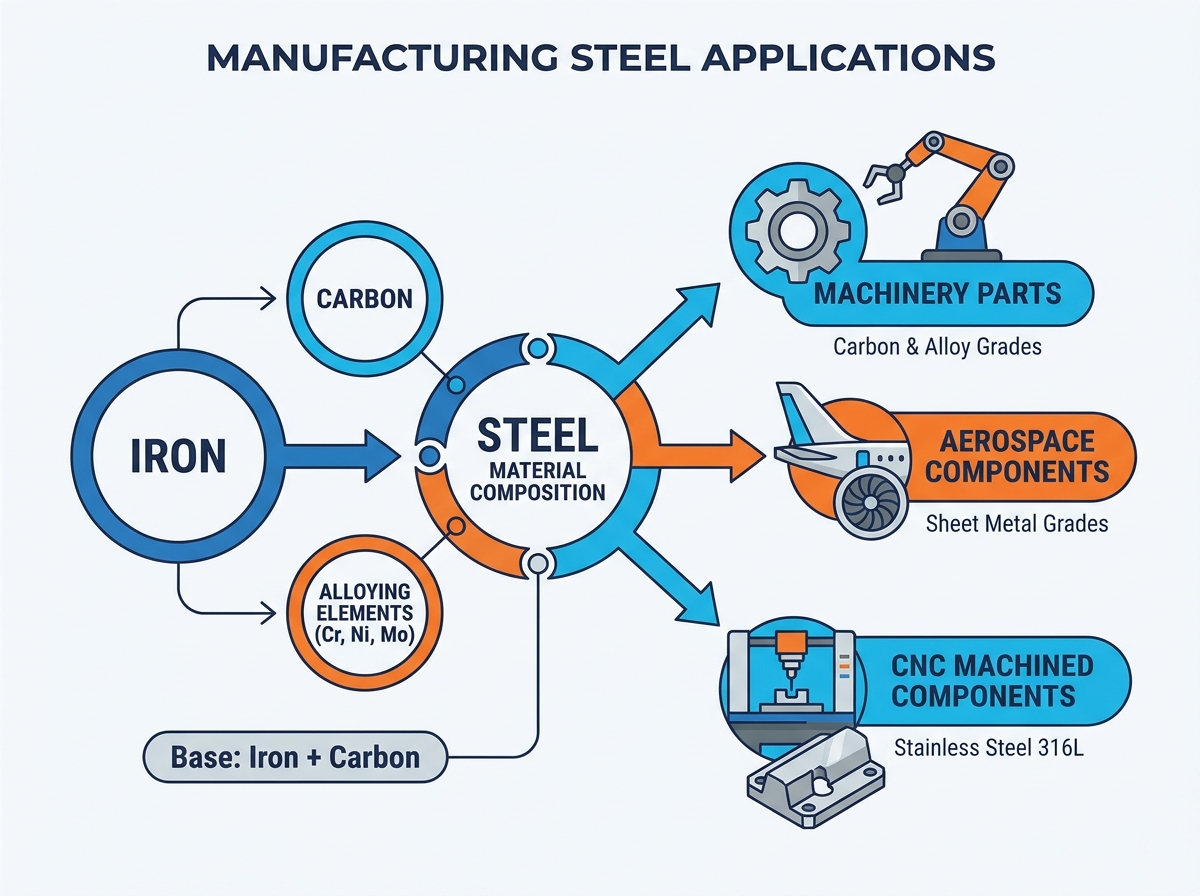
The transition from raw ore to usable mill stock involves aggressive thermal and mechanical processing. Manufacturers rely on specific furnace technologies depending on the desired alloy grade and available raw materials.
Melting and Refining: Manufacturers typically utilize either a Basic Oxygen Furnace (BOF) or an Electric Arc Furnace (EAF). The BOF relies heavily on liquid pig iron from a blast furnace, using high-velocity oxygen to reduce carbon levels. Conversely, the EAF utilizes high-power electrical arcs to melt a charge composed almost entirely of recycled scrap steel. The EAF method allows for highly precise control over alloy additions, making it the preferred method for producing complex, high-alloy specialty steels.
Casting and Rolling: Once the chemistry is locked in, the liquid steel moves to continuous casting machines. The molten metal is poured into water-cooled copper molds, solidifying into continuous lengths of billets, blooms, or slabs. Hot rolling occurs above the metal's recrystallization temperature, breaking down the cast microstructure and shaping the material without increasing its internal stress. Cold rolling is performed at room temperature. This process refines dimensional tolerances, improves surface finish, and strain-hardens the material. The direction of the rolling process physically aligns the grain structure, dictating the directional mechanical properties of the raw stock.
Cooling and Finishing: The controlled cooling rate directly affects the final hardness and internal stress of the steel. Rapid quenching traps carbon atoms in a distorted lattice, creating a highly hard but brittle martensitic structure. Slow cooling allows the carbon to diffuse, creating a softer, more ductile pearlitic structure. This final microstructural state dictates the baseline machinability of the steel when it arrives on the shop floor.
Industrial machinery components operate under relentless physical stress. Defining success criteria requires evaluating specific mechanical properties. Tensile strength is required to prevent components from pulling apart under heavy loads. The yield point dictates the exact stress level where permanent, unrecoverable deformation occurs. Fatigue resistance is mandatory for moving parts, as it stops microscopic surface cracks from propagating into catastrophic failures over thousands of operational cycles.
Selecting the right carbon and alloy steel grades for machinery parts requires balancing competing material traits. Low-carbon steels, such as 1018, offer excellent weldability and formability but lack the inherent strength for high-wear applications. High-carbon and alloy steels, such as 1045 or 4140, provide exceptional wear resistance and tensile strength. However, higher carbon content severely restricts weldability due to the risk of cracking in the heat-affected zone. Engineers must prioritize either weldability for fabricated assemblies or hardenability for high-wear gears and shafts.
Implementation reality on the shop floor often dictates material choice. The selected grade directly affects heat treatment cycles and the final dimensional stability of machined parts. Aggressive quenching of high-alloy steels can cause severe dimensional distortion or warping. To combat this, machinists frequently rough-cut parts, send them out for heat treatment, and then perform final hard-turning or grinding operations to achieve tight tolerances. Factoring these secondary operations into the initial material selection prevents unexpected cost overruns.
Consider the practical differences between common machinery grades:
1018 Carbon Steel: Excellent for cold forming and welding. Poor hardenability makes it unsuitable for high-wear shafts.
1045 Medium Carbon Steel: Good balance of strength and machinability. Can be flame or induction hardened for localized wear resistance.
4140 Alloy Steel: Contains chromium and molybdenum. Offers high fatigue strength and deep hardenability, ideal for heavy-duty gears and axles.
4340 Alloy Steel: Adds nickel to the 4140 base. Provides maximum toughness and impact resistance for the most severe mechanical shock applications.
Aerospace manufacturing operates under the strictest material constraints of any industry. The material requirements for aerospace sheet metal demand exceptionally high strength-to-weight ratios. Every ounce of excess weight translates to lost fuel efficiency and payload capacity. Furthermore, extreme fatigue resistance is non-negotiable. Airframe components experience constant cyclical loading due to flight pressurization, turbulence, and thermal expansion.
Corrosion and heat resistance are equally critical. Standard carbon steels degrade rapidly in atmospheric moisture and cannot withstand the intense heat generated by engine proximity or supersonic friction. Precipitation Hardening (PH) stainless steels, such as 17-4 PH, are frequently utilized. These specific alloys are non-negotiable for critical aerospace structures because they combine the superior corrosion resistance of austenitic stainless steels with the high strength and hardenability of martensitic grades.
Procurement teams face rigorous evaluation dimensions when sourcing steel grades for aerospace sheet metal components. Compliance with Aerospace Material Specifications (AMS) is mandatory. You cannot substitute commercial-grade equivalents. Traceability and batch consistency in raw material supply chains are heavily audited. Every piece of sheet metal must be accompanied by a Mill Test Report (MTR) verifying its exact chemical composition, heat lot number, and mechanical test results. Without this documentation, the material is entirely unusable for flight-critical applications.
Aerospace procurement teams must verify several data points on every MTR:
Exact chemical breakdown matching the AMS standard.
Mechanical properties including ultimate tensile strength and elongation.
Heat treatment condition at the time of delivery (e.g., Condition A, Condition H1150).
Ultrasonic testing results to confirm the absence of internal voids or inclusions.
In precision manufacturing, the "316L Advantage" makes it a dominant material choice. The "L" designation indicates a low-carbon composition, strictly capped at a maximum of 0.03%. This low carbon content prevents carbide precipitation at the grain boundaries when the material is exposed to high temperatures during welding. By keeping the grain boundaries intact, 316L remains highly corrosion-resistant even in the as-welded condition, making it the standard for complex, welded CNC assemblies.
Balancing machinability with performance requires specific shop-floor strategies. The addition of molybdenum gives 316L superior resistance to pitting and crevice corrosion, particularly in harsh acidic or chloride-rich marine environments. However, producing stainless steel 316L CNC machined components presents distinct machining challenges. The material work-hardens rapidly under the cutting tool. Machinists must manage tool wear by maintaining aggressive, constant feed rates. If a tool dwells or rubs against the workpiece, the surface hardens instantly, destroying the insert on the next pass. High-pressure coolant is mandatory to evacuate chips and control the intense heat generated during milling.
A clear decision framework helps determine when to specify 316L. Choose 316L over standard 304 stainless steel when the component faces direct exposure to chlorides, industrial chemicals, or marine environments. However, avoid 316L if the application requires a highly hardened wear surface. Austenitic steels like 316L cannot be hardened via standard heat treatment. If high hardness is required alongside corrosion resistance, a 400-series martensitic stainless steel is a more appropriate, albeit less corrosion-resistant, choice.
To optimize CNC milling of 316L, operators should implement the following parameters:
Use sharp, positive-rake carbide inserts to shear the material cleanly and minimize work-hardening.
Apply a heavy, continuous flow of water-soluble coolant directly to the cutting zone.
Avoid light finishing passes; ensure the depth of cut is always greater than the work-hardened layer from the previous pass.
Utilize climb milling techniques to reduce heat generation and extend tool life.
Material selection directly dictates manufacturing economics. The "Machinability Index" of a material is a critical metric. Composition-driven hardness directly impacts the cost-per-part calculation. Harder, high-alloy steels require slower spindle speeds, reduced feed rates, and frequent cutting tool replacements. While the raw material might fit the budget, the extended CNC cycle times and increased consumable costs can easily destroy product margins.
Evaluating secondary processes is equally important. Chemical composition influences the efficacy of surface finishing, plating, and hardening. For example, steels with high sulfur content machine beautifully because the sulfur creates short, easily evacuated chips. However, that same sulfur content complicates welding and can cause severe adhesion failures during zinc or nickel plating operations. You must evaluate different steel material options for CNC machining based on the entire production routing, not just the milling phase.
Strategic trade-offs are inevitable in procurement. You must balance cost-efficiency against the required material lifespan. Standard grades like 1018 or 6061 are readily available in various bar stock sizes, minimizing lead times. Conversely, highly specialized alloys may require custom-mill requirements, demanding massive minimum order quantities and months of lead time. Risk mitigation involves identifying and avoiding over-engineering. Specifying a high-end aerospace alloy for a low-stress industrial bracket unnecessarily drives up procurement costs without adding functional value.
When evaluating material options, cross-reference the following factors:
| Material Grade | Machinability Rating | Weldability | Ideal Application |
|---|---|---|---|
| 12L14 Free-Machining Steel | Excellent (160%) | Poor | High-volume turned parts with low stress requirements. |
| 1018 Carbon Steel | Good (78%) | Excellent | General structural brackets and welded assemblies. |
| 4140 Alloy Steel | Fair (65%) | Requires Pre-heating | High-stress shafts, gears, and heavy machinery components. |
| 316L Stainless Steel | Poor (36%) | Excellent | Marine hardware, chemical processing equipment. |
Selecting the optimal steel grade requires mapping exact end-use stress profiles directly to chemical composition requirements. To ensure your next manufacturing run is successful, execute the following steps:
Audit your current engineering drawings to replace generic material callouts with specific alloy grades and temper conditions.
Request Mill Test Reports (MTRs) from your raw material suppliers for all incoming stock to verify chemical compliance.
Consult your CNC machining partner during the design phase to identify potential tooling bottlenecks caused by high-hardness alloys.
Run a limited prototype batch to validate heat treatment responses and dimensional stability before authorizing full-scale production.
A: The primary raw materials include iron ore, metallurgical coke, limestone, and recycled scrap steel. Iron ore provides the base metal. Coke acts as a high-heat fuel and a chemical reducing agent. Limestone acts as a flux to remove impurities by forming slag. Scrap steel is added to help control furnace temperatures and increase overall production volume efficiently.
A: Carbon content directly dictates the hardness and tensile strength of the material. Low-carbon steels are softer and easier to cut but can produce long, stringy chips that tangle around tooling. High-carbon steels are significantly harder, which accelerates tool wear, requires slower cutting speeds, and demands highly rigid workholding to prevent vibration and chatter during machining.
A: 304 is the industry-standard austenitic stainless steel, suitable for general corrosion resistance and structural applications. 316L contains added molybdenum, which provides superior resistance to chlorides and acidic environments. The "L" indicates low carbon, making 316L ideal for welded assemblies because it prevents carbide precipitation and maintains corrosion resistance at the weld seams.
A: Aerospace components operate under extreme stress and strict regulatory oversight. Traceability ensures that every manufactured part can be linked back to its original melt batch via a Mill Test Report (MTR). This documentation guarantees the chemical composition meets exact Aerospace Material Specifications (AMS) and allows manufacturers to isolate potential defects if a material failure occurs.
A: Manganese increases the hardenability, tensile strength, and wear resistance of the steel while also helping to deoxidize the melt during primary refinement. Nickel significantly improves the material's toughness and impact resistance, particularly in low-temperature environments, while also enhancing overall corrosion resistance when combined with chromium.
A: Standard heat treatment processes, such as quenching and tempering, only alter the internal crystalline grain structure of the steel to modify its mechanical properties like hardness and ductility. They do not change the fundamental chemical composition. However, specialized surface treatments like carburizing or nitriding do intentionally add carbon or nitrogen to the outer layer of the metal.


