
English ![]()

No. 7, Tianyang 6th Road, Dongfang Community, Songgang Street, Bao'an District, Shenzhen, Guangdong, China(518100)
Views: 0 Author: Site Editor Publish Time: 2026-11-03 Origin: Site
Selecting the correct steel grade for industrial and heavy machinery dictates operational uptime, safety, and supply chain stability. In demanding mechanical environments, material failure translates directly to catastrophic downtime and severe safety liabilities. Engineers and procurement teams constantly navigate the tension between over-engineering—wasting budget on unnecessarily high-grade alloys—and under-engineering, which risks premature wear, corrosion, or structural failure by specifying inadequate steel grades.
Solving this problem requires a rigorous evaluation framework. You must match specific steel grades and raw material forms, such as heavy plates, bars, and wire, to their exact mechanical environments. Beyond material selection, partnering with capable fabrication services ensures that theoretical design intent meets manufacturing reality on the factory floor.
Performance-to-Environment Matching: Selecting the right steel requires balancing yield strength, hardness, and corrosion resistance against the specific operational environment of the machinery, from shipbuilding to earth-moving equipment.
Alloy Trade-Offs: The choice between carbon steel and stainless steel hinges on weighing initial material costs against long-term maintenance, chemical coating requirements, and replacement cycles.
Precision Fabrication is Critical: Even the highest-grade steel will fail if subjected to improper welding, bending, or machining; vetting fabrication partners is as important as the material specification itself.
Traceability Mitigates Risk: Requiring Material Test Reports (MTRs) and strict quality control protocols prevents the introduction of counterfeit or substandard steel into critical machinery components.
Before evaluating specific alloys, engineering teams must define the baseline requirements of the machinery. Evaluating steel material applications begins with a strict assessment of mechanical stress, environmental exposure, and manufacturability. Skipping this phase leads to components that either fail in the field or cannot be manufactured efficiently.
To establish a functional baseline, engineers typically follow a strict sequence of evaluation:
Calculate the maximum dynamic and static loads the component will experience during peak operation.
Identify all environmental corrosives, including ambient humidity, chemical exposure, and temperature extremes.
Determine the required manufacturing processes based on the raw material form and final dimensional tolerances.
Assess the interaction between the new component and existing dissimilar metals within the assembly.
Dynamic machinery parts experience constant physical strain. Engineers must calculate tensile strength, yield strength, and fatigue limits for components like crankshafts, train wheels, heavy-duty springs, and coils. Yield strength determines how much stress a material can take before permanent deformation occurs. Tensile strength measures the maximum stress before absolute failure. If a heavy-duty excavator bucket uses steel with a low yield strength, the metal will permanently bend the first time it strikes bedrock.
In heavy-duty industrial applications, continuous vibration and cyclic loading severely impact material lifespan. A component might survive a single massive impact but fail under millions of smaller, repeated loads. Understanding the S-N curve (stress versus number of cycles) for a specific steel grade ensures that dynamic components will not suffer from premature fatigue failure. For example, a rotating drive shaft in a conveyor system undergoes alternating tension and compression with every revolution. Specifying a steel with a high fatigue limit, such as 4140 chromoly, prevents microscopic cracks from propagating into catastrophic fractures.
Machinery rarely operates in pristine conditions. Equipment deployed in harsh environments—such as chemical plants, oil tanks, pipeline repairs, and marine shipbuilding—requires materials capable of withstanding aggressive degradation. You must evaluate the exact chemical exposure, ambient humidity, and extreme temperature fluctuations the machinery will face. A steel grade that performs perfectly in a dry, climate-controlled warehouse will disintegrate within months on an offshore drilling rig.
Galvanic corrosion presents a massive risk in complex machine assemblies. When dissimilar metals, such as carbon steel and aluminum, physically touch in the presence of an electrolyte like saltwater, the less noble metal corrodes rapidly. Mitigating this requires selecting compatible steel grades or engineering physical isolation barriers, such as dielectric unions or non-conductive isolation pads, between dissimilar materials.
The physical properties of a chosen steel grade directly impact manufacturing lead times and tooling costs. High-hardness steels rapidly wear down cutting tools and require slower machining speeds, driving up production costs. Machinists must lower their surface feet per minute (SFM) and use specialized carbide or ceramic inserts to cut through hardened alloys. Conversely, highly ductile steels might gum up tooling or suffer from poor surface finishes if not machined with the correct chip-breaking geometry.
The starting form of the raw material dictates fabrication methods. Heavy steel plates serve as structural bases and require high-tonnage press brakes or plasma cutters. Rods and bars form drive shafts and rely on precision CNC turning. Steel wire, used for gating and fencing components, requires specialized bending and welding automation. Aligning the raw material form with the design tolerances ensures efficient manufacturing and minimizes material waste.
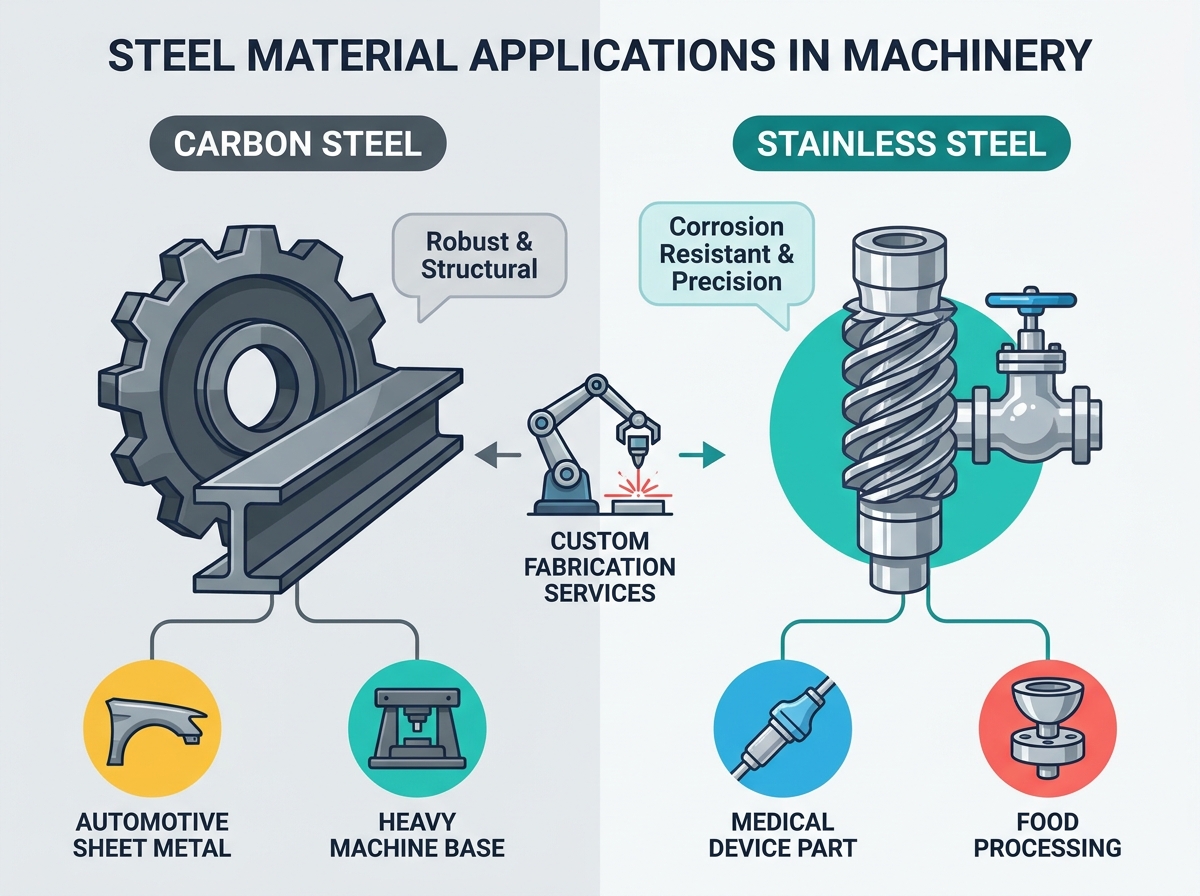
When engineering carbon steel and stainless steel machinery parts, procurement teams must weigh distinct advantages, limitations, and ideal use cases to maximize component lifespan. The decision rarely comes down to a single variable; it requires a holistic view of the machine's intended lifecycle.
Carbon steel dominates heavy machinery construction due to its exceptional strength-to-cost ratio. Low-carbon steel (like A36 or 1018) provides excellent formability and weldability for structural frames, base plates, and safety guards. Medium and high-carbon steels (like 1045 or AR400) deliver the wear resistance and tensile strength required for earth-moving machinery, excavator buckets, and construction equipment.
Carbon steel lacks inherent corrosion resistance. Without protection, it rapidly oxidizes when exposed to moisture or oxygen. Mitigation strategies are mandatory. Manufacturers must specify chemical coatings from finishing mills, apply industrial powder coating, utilize hot-dip galvanization, or engineer automated lubrication systems to shield carbon steel components from environmental moisture and chemical exposure. If a painted carbon steel frame gets scratched down to bare metal on a job site, rust will immediately begin undercutting the surrounding paint.
Austenitic stainless steels serve applications where hygiene or chemical resistance is non-negotiable. Food processing equipment, pharmaceutical machinery, and cookware manufacturing rely on stainless steel to prevent contamination and withstand harsh washdown chemicals. These environments use caustic cleaners that would strip the paint off carbon steel and dissolve the metal underneath.
The higher price point of stainless steel stems from its alloying elements. Grade 304 contains 18% chromium and 8% nickel, forming a passive oxide layer that prevents rust. Grade 316 adds 2-3% molybdenum, drastically increasing resistance to chlorides and pitting corrosion. You specify 316 when machinery operates near seawater, handles aggressive industrial solvents, or processes acidic foods like tomatoes or citrus.
Standard carbon and stainless grades fail rapidly in highly abrasive environments. Cutting tools, drills, stamping dies, and heavy-duty gears require specialized tool and alloy steels. Materials like D2, H13, or O1 contain precise additions of tungsten, vanadium, or cobalt to maintain cutting edges at high temperatures without losing their temper.
Heat treatment unlocks the true potential of these alloys. Processes like quenching and tempering alter the internal microstructure, transforming soft, machinable annealed steel into martensite. This achieves the massive surface hardness and impact resistance necessary for metal-forming and rock-crushing applications. A stamping die made of unhardened steel would deform after a few dozen cycles; a properly heat-treated D2 die can stamp hundreds of thousands of parts before requiring sharpening.
| Steel Category | Primary Alloying Elements | Key Mechanical Strengths | Common Machinery Applications | Primary Vulnerability |
|---|---|---|---|---|
| Low Carbon Steel (A36, 1018) | Carbon (up to 0.3%), Iron, Manganese | High ductility, excellent weldability, cost-effective | Structural frames, heavy equipment chassis, brackets | Rapid oxidation without surface coatings |
| High Carbon / AR Steel | Carbon (0.6% - 1.0%), Iron | Extreme abrasion resistance, high tensile strength | Excavator buckets, mining chutes, bulldozer blades | Poor weldability, brittle under high impact |
| 304 Stainless Steel | Chromium (18%), Nickel (8%) | Good general corrosion resistance, easy to clean | Food processing vats, pharmaceutical conveyors | Susceptible to chloride pitting (saltwater) |
| 316 Stainless Steel | Chromium, Nickel, Molybdenum | Superior corrosion and pitting resistance | Marine equipment, chemical processing pumps | High material cost, prone to galling |
| Tool Steel (D2, H13) | Tungsten, Vanadium, Chromium | Extreme hardness, wear resistance at high temperatures | Stamping dies, cutting blades, industrial drill bits | Difficult to machine, requires complex heat treatment |
The manufacturing of steel automotive sheet metal components requires a delicate balance between structural rigidity, weight reduction, and passenger safety. The intersection of heavy machinery and automotive manufacturing demands materials that perform flawlessly under extreme dynamic loads while remaining light enough to meet efficiency standards.
Heavy trucks used for earthwork projects and commercial transport rely on high-strength, low-alloy (HSLA) steels for their chassis and structural frames. HSLA steels provide significantly higher yield strengths than standard carbon steels without a proportional increase in weight. They achieve this through micro-alloying with elements like niobium, vanadium, and titanium.
This weight-to-strength ratio dictates vehicle performance. Reducing the dead weight of a commercial vehicle frame directly improves fuel efficiency and increases payload capacity. HSLA steels allow engineers to design thinner structural cross-sections that maintain the absolute rigidity required to haul heavy machinery or bulk materials over rough terrain. A thinner frame rail made of HSLA steel will outperform a thick, heavy rail made of standard A36 mild steel.
Automotive sheet metal must undergo severe deformation during manufacturing. Deep drawing, complex stamping, and roll forming require steel grades with high ductility to prevent tearing or wrinkling in the die. Engineers must calculate the plastic strain ratio and the work-hardening exponent to ensure the flat sheet can stretch into complex fender or door panel geometries without fracturing.
Crashworthiness dictates material selection for structural pillars and impact zones. Specific steel grades, such as dual-phase (DP) or transformation-induced plasticity (TRIP) steels, are engineered to absorb massive amounts of impact energy. During a collision, these materials deform predictably, maintaining the integrity of the passenger cabin or operator enclosure while dissipating kinetic energy away from the occupants. TRIP steels actually harden as they deform, providing increasing resistance as the crash progresses.
Designing stainless steel 316L automotive worm gears presents unique metallurgical challenges. A worm gear assembly involves high-friction, sliding contact that normally demands ultra-hard carbon alloys. Specifying 316L indicates an environment where corrosion resistance completely overrides the need for raw surface hardness.
The "L" in 316L stands for low carbon (maximum 0.03%). This metallurgical property prevents carbide precipitation during welding and high-temperature operation, ensuring the material retains its corrosion resistance at the grain boundaries. The high molybdenum content makes it impervious to road salts, chemical washdowns, and marine environments.
Engineers choose 316L for specialized automotive applications—such as exposed winch mechanisms, marine steering columns, or chemical transport valves—despite its relatively low hardness compared to dedicated gear steels like 8620 or 9310. In these niche applications, a standard high-carbon gear would rapidly rust and seize. The corrosion immunity of 316L becomes the primary operational requirement, forcing engineers to solve the hardness problem through other methods.
Austenitic stainless steels perform poorly in sliding contact. They are highly susceptible to galling and adhesive wear, where microscopic high points on the gear teeth cold-weld together and tear apart under torque. Left unmitigated, a 316L worm gear will quickly destroy itself, leaving metal shavings in the gearbox and seizing the mechanism entirely.
Mitigation requires aggressive engineering interventions. Surface treatments like nitriding diffuse nitrogen into the steel, creating a hard, wear-resistant case without sacrificing core corrosion resistance. Engineers also pair the 316L worm with a dissimilar metal, such as a bronze worm wheel, to eliminate the metal-on-metal affinity that causes galling. Advanced, high-pressure synthetic lubrication protocols are mandatory to maintain a protective hydrodynamic film between the meshing teeth.
Executing a material strategy requires partnering with reliable custom steel sheet metal fabrication services. Even the most precise engineering drawings fail if the manufacturing vendor lacks the equipment, expertise, or quality control to process the raw steel correctly.
A fabricator's technological infrastructure dictates their ability to hold tight tolerances. You must evaluate their specific machinery. Fiber laser cutting systems must handle thick plates without inducing excessive heat-affected zones (HAZ) that harden the edges and ruin subsequent machining operations. CNC press brakes require adequate tonnage and advanced crowning systems to bend high-strength structural beams without bowing in the center.
Experience with specific alloys matters. Welding 316L stainless steel requires completely different shielding gases, filler metals, and heat inputs compared to welding high-carbon steel. Using the wrong gas mixture on stainless steel introduces carbon into the weld pool, destroying its corrosion resistance. Vendors must demonstrate proven robotic or certified manual welding capabilities tailored to the exact materials specified in your machinery blueprints.
Raw steel rarely goes directly into heavy machinery without surface treatment. Evaluate a vendor's access to finishing mills or in-house coating lines. The ability to apply chemical treatments, zinc plating, or hot-dip galvanization to raw steel wire, pipes, and sheets under one roof reduces supply chain logistics and prevents flash rusting during transit. A vendor that handles both fabrication and powder coating ensures that the parts are prepped, blasted, and coated immediately after welding.
Counterfeit or off-spec steel introduces catastrophic risk into machinery manufacturing. Vendors must operate under strict ISO certifications and employ rigorous inspection protocols, including Coordinate Measuring Machines (CMM) for dimensional accuracy and non-destructive testing (NDT) like dye penetrant or ultrasonic testing for weld integrity.
Material traceability is non-negotiable. You must require Material Test Reports (MTRs) for every batch of steel. These documents verify the exact chemical composition and mechanical properties of the sourced metal, proving that the physical plates or bars match the engineering specifications. Without an MTR, you have no proof that the vendor actually used 316L instead of cheaper 304.
Final procurement decisions rely on a comprehensive evaluation of lifecycle value rather than just the initial purchase order price. Engineers and purchasing managers must align on the long-term financial impact of material selection.
Specifying stainless steel requires a high upfront capital investment compared to standard carbon steel. Evaluating the true cost requires looking at the entire operational lifespan of the machinery. A cheaper carbon steel component might save money initially, but it often demands recurring maintenance, frequent chemical coating reapplications, and expensive production downtime.
In corrosive environments, the cheaper carbon steel part will require early replacement. When factoring in the labor to replace the part, the logistics of shipping a heavy replacement component, and the lost revenue from stopped machinery, the initially expensive stainless steel component delivers a vastly superior long-term financial return. You pay once for the right material, rather than paying continuously for maintenance and downtime.
Global steel markets experience heavy volatility. Material availability fluctuates wildly across different forms, including sheet, plate, coil, and bar stock. Specifying a rare, highly specialized alloy can lead to manufacturing bottlenecks if the supply chain tightens and mills stop producing that specific grade.
To mitigate these risks, engineering teams should standardize material grades across multiple machinery parts wherever possible. Consolidating material requirements increases purchasing power and simplifies inventory. Establishing long-term agreements with reliable fabrication partners ensures priority access to raw materials and stable production lead times, even during market shortages.
Successful steel material applications depend entirely on a rigorous, data-driven matching of metallurgical properties to the specific mechanical and environmental demands of the machinery. You cannot guess at yield strengths or assume corrosion resistance; every material choice must align with the operational reality the equipment will face.
To ensure your machinery components meet performance expectations and manufacturing realities, execute the following steps:
Audit your current machinery blueprints to identify components suffering from premature wear, fatigue, or corrosion.
Consult with a metallurgist to calculate the exact yield strength, fatigue limits, and chemical resistance required for those failure points.
Standardize your material selections across assemblies to reduce supply chain complexity and lower procurement costs.
Request a capability brief and material quote from a vetted custom steel fabrication service to verify they possess the required CNC equipment and welding certifications.
Mandate the inclusion of Material Test Reports (MTRs) on all future purchase orders to guarantee material traceability.
A: Carbon steel offers exceptional tensile strength and is highly cost-effective, making it ideal for heavy structural frames. However, it rusts easily and requires protective coatings. Stainless steel contains chromium and nickel, providing superior inherent corrosion resistance for harsh chemical or marine environments, though at a significantly higher upfront material cost.
A: Steel is utilized in several raw forms depending on the application. Heavy steel plates are used for structural bases and oil tanks. Pipes and tubes frame roll cages and transport fluids. Solid bars and rods are machined into drive shafts and axles, while steel wire is fabricated into gating, fencing, and heavy-duty springs.
A: 316L is selected for worm gears operating in highly corrosive environments, such as marine or chemical transport applications, where standard gear steel would rust and seize. Because 316L is susceptible to galling under high friction, it requires specialized surface treatments like nitriding and advanced lubrication to function effectively.
A: You must evaluate three core factors: mechanical load-bearing requirements (calculating yield strength and fatigue limits for dynamic parts), environmental exposure (assessing the need for chemical or moisture resistance), and manufacturability (ensuring the steel can be efficiently machined, formed, and welded by your fabrication partner).
A: Prioritize vendors with advanced equipment tolerances, such as high-tonnage CNC press brakes and fiber lasers. Verify their experience welding your specific alloys. Ensure they offer in-house finishing or coating capabilities and demand strict quality control, specifically the provision of Material Test Reports (MTRs) for full traceability.
A: Tool steels (like D2 or H13) and specialized alloy steels are best for high-wear applications. These materials contain elements like tungsten and vanadium. When subjected to heat treatment processes like quenching and tempering, they achieve the extreme surface hardness necessary for cutting tools, stamping dies, and heavy-duty drills.
A: Selecting cheaper, inadequate materials often leads to frequent maintenance, unexpected equipment downtime, and premature part replacement. Investing in a higher-grade, environment-appropriate steel upfront drastically reduces recurring repair costs, eliminates the need for constant recoating, and extends the uninterrupted operational lifespan of the machinery.


