
English ![]()

No. 7, Tianyang 6th Road, Dongfang Community, Songgang Street, Bao'an District, Shenzhen, Guangdong, China(518100)
Views: 0 Author: Site Editor Publish Time: 2026-11-01 Origin: Site
The shift from internal combustion engines to electric vehicles completely rewrites automotive machining rules. We no longer push heavy cast-iron engine blocks through transfer lines. Instead, engineering teams require complex, thin-walled, lightweight alloy structures and highly conductive metals. CNC machining for EV manufacturing has to adapt to these extreme material and geometric changes.
Original equipment manufacturers and Tier 1 suppliers hit a bottleneck when scaling production while holding the micro-tolerances necessary for battery safety, thermal management, and drivetrain efficiency. Standard job shops lack the rigidity, thermal control, technical cleanliness, and metrology to meet these specifications. Legacy equipment simply fails at the micron-level precision needed for modern electric drivetrains.
Specialized machining facilities solve this by deploying advanced multi-axis equipment, automated metrology, optimized tooling, and strict contamination controls. This guide details how to evaluate and select a machining partner capable of delivering aerospace-grade precision at automotive volumes.
Material Shift: EV manufacturing relies heavily on extruded aluminum, magnesium, copper, and advanced composites, requiring CNC partners with high-speed machining (HSM) capabilities and specialized chip evacuation systems.
NVH Strictness: The absence of ICE noise means EV drivetrain components demand superior surface finishes and tighter geometric dimensioning and tolerancing (GD&T) to eliminate gear whine and vibration.
Complex Geometries: Consolidating parts to save weight necessitates advanced 5-axis CNC machining, particularly for intricate fluid channels in thermal management systems and reducer housings.
Gigacasting Integration: While large-scale die casting is consolidating structural parts, it creates a new demand for large-envelope CNC machines to perform high-precision finishing on mating surfaces and mounting points.
Vendor Viability: Selecting a partner requires evaluating their adherence to IATF 16949 standards, in-machine probing capabilities, technical cleanliness protocols (e.g., VDA 19), and strategies for mitigating thermal distortion during the machining of large, thin-walled parts.
Baseline expectations for EV components differ drastically from legacy automotive parts. Success is no longer about pushing high volumes of cast iron through a transfer line. It requires aggressive weight reduction, maximizing thermal efficiency, ensuring acoustic performance, and guaranteeing electrical safety. Machining facilities must overhaul their entire approach to part processing.
| Parameter | Legacy ICE Machining | EV Component Machining |
|---|---|---|
| Primary Materials | Cast iron, forged steel, low-grade aluminum | 6061/7075 Aluminum, Magnesium, Copper, A356-T6 |
| Machining Strategy | Heavy depth of cut, low RPM, high torque | High-speed machining (HSM), light cuts, high feed rates |
| Tolerances & NVH | Standard automotive tolerances, noise masked by engine | Micron-level concentricity, Ra 0.4 surface finishes |
| Cleanliness Standard | Visual inspection, standard wash lines | ISO 16232 / VDA 19, cleanroom packaging, zero conductive debris |
Electric vehicles rely on lightweight alloys to offset massive battery weight and extend driving range. Machining 6061-T6 aluminum, 7075 aluminum, and magnesium alloys is standard practice on the modern shop floor. These materials present unique challenges. Aluminum alloys are prone to built-up edge (BUE) on cutting tools. The material literally welds itself to the cutting edge under heat and pressure, destroying surface finish and altering tool geometry.
Preventing BUE requires optimized coolant strategies and specialized cutting tools. High-pressure coolant delivery systems must blast chips away from the cutting zone instantly. Facilities processing high volumes of abrasive aluminum alloys utilize Polycrystalline Diamond (PCD) tools. PCD tooling maintains sharp cutting edges significantly longer than standard carbide. While a carbide end mill might last 40 minutes in high-silicon aluminum, a PCD tool runs for weeks, holding a 10-micron tolerance without edge degradation.
The silent operation of electric motors exposes mechanical noises previously masked by loud combustion engines. Gear whine, bearing rumble, and rotor vibration become highly noticeable to the driver. EV transmission and motor components demand incredibly strict NVH standards to combat this.
Achieving these standards requires exceptional surface roughness (Ra) values and extremely tight concentricity tolerances. Bearing journals and gear mounting surfaces often require single-digit micron tolerances. Advanced CNC controllers with look-ahead capabilities ensure smooth toolpaths, preventing micro-stuttering during interpolation. Machinists utilize vibration-damping tool holders, such as hydraulic expansion chucks or shrink-fit systems, to eliminate runout and achieve mirror-like surface finishes.
Electrical safety introduces a massive shift in automotive machining. Conductive metal chips or microscopic burrs left on components cause catastrophic short circuits in high-voltage battery systems. A single stray aluminum chip inside a battery enclosure can bridge a connection, leading to thermal runaway.
Adhering to strict cleanliness standards like ISO 16232 and VDA 19 is non-negotiable. Machine shops implement rigorous contamination control measures. These adaptations include automated multi-stage ultrasonic cleaning lines equipped with vacuum drying chambers to strip away microscopic debris and cutting fluids. High-pressure deburring systems use targeted water jets at 5,000 PSI to remove clinging burrs from deep intersecting holes. Parts then undergo cleanroom-level packaging protocols in anti-static bags to prevent contamination during transit.
Specific EV subsystems require highly specialized CNC machining processes. Outsourcing these components demands a partner with proven experience in the exact part family. The following categories map specific vehicle systems to their required manufacturing technologies.
Battery trays are machined from large-format extruded aluminum profiles. These structures house the heavy battery cells and provide crash protection. Machining these massive frames requires large-travel gantry mills capable of maintaining accuracy over spans of two to three meters. The extrusions require precise edge preparation for subsequent friction stir welding (FSW) operations.
Thermal management is equally demanding. Liquid cooling channels, known as cold plates, must be precision-milled to circulate coolant beneath the battery cells. Flatness and surface finish dictate success here. Any deviation in flatness creates air gaps, reducing thermal transfer efficiency, or causes coolant leaks. Maintaining flatness over large surface areas requires specialized vacuum fixturing strategies to hold the thin plates securely without inducing mechanical stress during the milling cycle.
Electric motor housings feature complex internal cooling jackets designed to pull heat away from the stator. Machining these thin-walled cylindrical housings requires extreme care to prevent clamping distortion. If the chuck pressure is too high, the housing machines perfectly round but springs into an oval shape once released from the jaws. Machinists use custom pie jaws or hydraulic expansion arbors to distribute clamping force evenly.
Deep-hole drilling and precision boring are essential operations for stator components. Maintaining tight concentricity between the stator bore and the bearing journals at each end of the housing is absolute. Any misalignment causes the rotor to rub against the stator or induces severe vibration at 15,000+ RPMs.
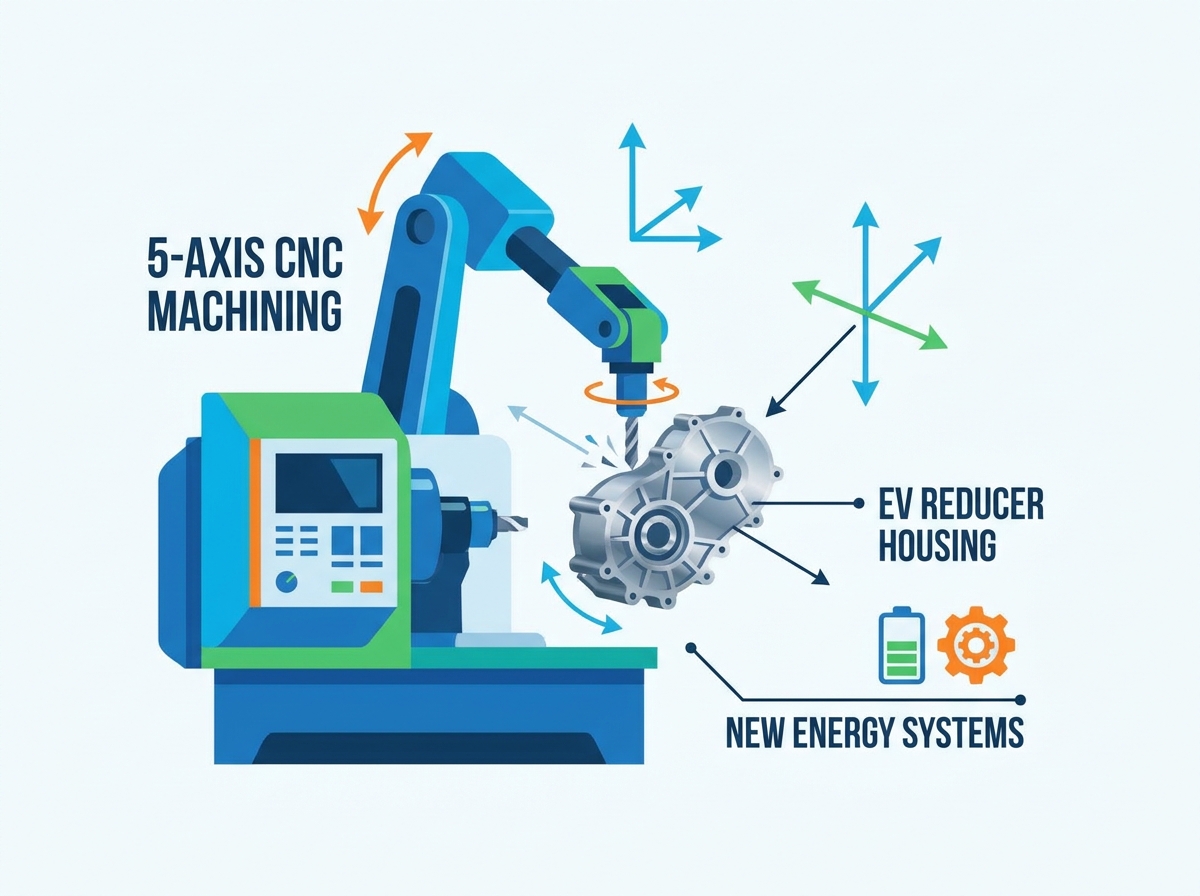
EV single-speed or two-speed reducers require highly complex, consolidated housings. These components integrate multiple bearing bores, fluid galleries, and mounting flanges into a single casting. 5-axis CNC machining for EV reducer housings is the only viable way to process these parts efficiently.
Utilizing 5-axis technology drastically reduces setup times. Instead of moving the part across multiple 3-axis machines, the spindle approaches the workpiece from nearly any angle. This minimizes tolerance stack-up errors caused by repeated clamping and unclamping. It allows for the machining of complex internal geometries and compound angles in a single operation. When evaluating a vendor, assess their trunnion table rigidity and verify if they utilize simultaneous 5-axis contouring or simpler 3+2 positional machining.
Power distribution in electric vehicles requires a massive increase in copper usage. High-voltage terminals and busbars carry hundreds of amps between the battery, inverter, and motor. CNC machining copper presents specific challenges due to the material's inherent gumminess and high ductility.
Copper tends to gall and stick to cutting tools, causing rapid tool wear and torn surface finishes. Machinists use highly polished, uncoated carbide tools with sharp rake angles to shear the material cleanly. Specialized geometries are required to machine the intricate connection points on high-voltage terminals, demanding rigid micro-machining capabilities and high-RPM spindles.
The industry trend of megacasting or gigacasting involves injecting molten aluminum into massive dies to form entire front and rear underbodies. While this consolidates dozens of stamped parts, it does not eliminate the need for machining. Gigacastings still require high-precision finishing to function properly.
CNC machining is necessary to mill critical mating surfaces where the battery pack or suspension components attach. Large-bridge or gantry-style CNC mills drill and tap hundreds of mounting holes across the massive casting. The challenge lies in managing the sheer size of the workpiece while holding tight positional tolerances across spans of two meters or more. Spindle probes are used extensively to establish datums on the raw casting before any cutting begins.
Procurement and engineering teams assess potential manufacturing partners through specific technical lenses. The equipment on the shop floor dictates the quality, precision, and scalability of the final product.
High-Speed Machining (HSM) involves running spindle speeds exceeding 20,000 RPM paired with exceptionally high feed rates. In the context of EV parts, HSM is about cutting smarter. Taking light, fast passes minimizes radial cutting forces and heat generation.
Reducing cutting forces is vital when processing thin-walled battery enclosures and motor casings. Heavy cuts push the thin walls away from the tool, causing chatter and dimensional inaccuracies. HSM slices through the material before it has a chance to deflect, reducing the risk of warping or deforming delicate structural components. This requires rigid machine frames and HSK-A63 or HSK-A100 spindle tapers to handle the high rotational speeds without vibration.
Bridging the gap between high-mix prototyping and high-volume automotive production requires robust automation. Robotic machine tending and multi-station pallet pools allow CNC machines to run unattended for hours or even days.
Automation ensures absolute process repeatability. A robot loads a part with the exact same force and positioning every single time, eliminating human error. Operators load raw material onto tombstones outside the machine while the spindle continues cutting on another pallet. This consistency lowers the per-part cost for large-scale EV rollouts and ensures production schedules remain insulated from labor shortages.
Closed-loop manufacturing is a mandatory adaptation for EV components. CNC machines utilize spindle probes to verify part dimensions before unclamping the workpiece. The workflow typically follows these steps:
The probe touches the raw casting to establish the exact X, Y, and Z datums, compensating for casting variations.
The machine executes the roughing and semi-finishing toolpaths.
The probe measures the semi-finished features to detect any tool wear or deflection.
The CNC controller automatically updates the tool wear offsets based on the probe data.
The machine executes the final finishing pass, guaranteeing the feature is perfectly to size.
This real-time metrology prevents scrap in high-value castings. Discovering a dimensional error in the quality control lab after the part is removed from the fixture is too late. In-machine probing ensures immediate adherence to GD&T specifications and guarantees only conforming parts leave the machining envelope.
Efficient chip evacuation in deep cavities requires high-pressure coolant systems, delivering fluid at 1,000 PSI directly through the tool. This blasts chips out of blind holes, preventing tool breakage and surface scoring during deep-hole drilling operations.
Alternatively, Minimum Quantity Lubrication (MQL) is gaining traction on EV machining lines. MQL uses a fine mist of oil and compressed air instead of flood coolant. This adaptation reduces thermal shock to the cutting tool, improving surface finish and extending tool life. MQL aligns with the sustainability goals of EV manufacturers by minimizing hazardous coolant waste and eliminating the need for energy-intensive coolant pumps.
Selecting a CNC machining vendor for EV programs involves complex business-level criteria. Engineering teams weigh conceptual trade-offs when sourcing new energy parts manufacturing services.
Automotive quality management requires strict adherence to international standards. Mandate the requirement for IATF 16949 certification. This certification proves the facility operates with rigorous risk management, defect prevention, and continuous improvement protocols tailored specifically for the automotive supply chain.
Material traceability is equally vital. Vendors provide comprehensive documentation tracking raw material lots to finished components. Assess their First Article Inspection (FAI) and Production Part Approval Process (PPAP) capabilities. A reliable partner seamlessly generates Level 3 PPAP documentation, providing full confidence in their manufacturing process control.
The EV market moves rapidly. A vendor supports rapid prototyping during the R&D phase and seamlessly transitions those prototypes into mass production. Evaluate their engineering support during the initial design phase.
Dedicated NPI cells are a strong indicator of a capable partner. These isolated machining cells allow engineers to prove out toolpaths, design custom fixturing, and run prototype batches without disrupting ongoing high-volume production lines. This separation ensures urgent prototype requests do not cause delays in existing supply contracts.
Procurement teams compare the upfront costs of custom workholding against long-term unit cost reductions. Hydraulic tombstone fixtures are expensive to design and build, but they allow multiple parts to be machined simultaneously, drastically reducing cycle times.
Deciding when to invest in dedicated machining cells depends on the EV platform's lifecycle. For a high-volume, multi-year vehicle program, investing in a dedicated, automated cell yields the lowest per-part cost. For lower-volume luxury EVs or commercial platforms, utilizing flexible, shared equipment minimizes upfront capital expenditure.
Global supply chain disruptions pose severe risks to the EV sector. Relying on components shipped across the ocean introduces lead time volatility and massive freight costs, especially for heavy, bulky components.
Evaluate the value of partnering with nearshore or domestic CNC facilities. Sourcing battery trays and massive motor housings locally reduces transit times from weeks to days. It simplifies logistics, lowers carbon footprints associated with shipping, and allows engineering teams to visit the manufacturing floor easily for rapid troubleshooting.
OEMs increasingly require their Tier 1 and Tier 2 suppliers to demonstrate Environmental, Social, and Governance (ESG) compliance. Building a zero-emissions vehicle using highly polluting manufacturing processes contradicts the core mission of the EV industry.
Evaluate partners based on their eco-friendly machining practices. Look for facilities that utilize renewable energy sources to power their CNC equipment. Robust metal chip recycling programs, swarf briquetting machines, and the use of biodegradable cutting fluids or MQL systems indicate a strong commitment to sustainable manufacturing.
Machining EV components involves significant technical hurdles. Elite CNC partners anticipate these failures and implement robust preventative measures on the shop floor.
| Implementation Risk | Root Cause | Mitigation Strategy |
|---|---|---|
| Thermal Distortion in Large Parts | Heat generated during aggressive milling causes aluminum battery trays to warp out of tolerance once unclamped. | Utilize high-volume flood coolant, temperature-controlled machining environments, and stress-relief annealing prior to final finishing. |
| Rapid Tool Wear in Abrasive Alloys | High silicon content in certain aluminum die castings acts like sandpaper on cutting edges. | Deploy predictive tool life monitoring software and utilize PCD (Polycrystalline Diamond) coated tooling. |
| High Scrap Rates in Complex Castings | Programming errors or unexpected tool collisions on near-net-shape castings cause massive financial losses. | Mandate the use of advanced CAM simulation software (e.g., Vericut) to verify toolpaths and detect collisions virtually before physical machining. |
| Conductive Debris in High-Voltage Systems | Microscopic metal burrs dislodge during vehicle operation, causing catastrophic battery or inverter shorts. | Implement automated thermal or electrochemical deburring, followed by validated ultrasonic cleaning and cleanroom packaging. |
Aggressive milling generates substantial heat. Aluminum has a high coefficient of thermal expansion (roughly 23 µm/m°C). When machining large aluminum battery trays, heat absorbs into the workpiece, causing the metal to expand. If the part is machined to size while warm, it shrinks out of tolerance as it cools on the inspection table.
Mitigating this risk requires strict thermal management. Vendors use high-volume flood coolant systems to pull heat away from the cutting zone instantly. The machining environment itself is temperature-controlled. For highly critical components, stress-relief annealing processes are required before the final light finishing passes are taken to ensure dimensional stability.
Many EV structural components utilize high-silicon aluminum castings (like A356-T6) for improved fluidity during the casting process. Silicon is highly abrasive. It accelerates tool wear, leading to out-of-tolerance features, increased spindle loads, and poor surface finishes.
Ensure the machining partner utilizes predictive tool life monitoring software. This software tracks the exact cutting time of every tool and flags it for replacement before the edge degrades completely. Appropriate diamond-coated tooling or solid PCD inserts are mandatory to withstand the abrasive nature of these specific alloys during high-volume production.
Machining errors on a complex, near-net-shape EV casting result in massive financial losses. A single gigacasting or intricate inverter housing represents significant upstream value. Scrapping the part at the CNC machine is unacceptable.
Verify the use of advanced CAM simulation software. Programs like Vericut create a digital twin of the CNC machine, fixture, tool, and workpiece. Engineers simulate the entire machining process virtually to detect collisions, gouges, and optimize toolpaths prior to any physical metal removal on the shop floor.
Microscopic metal burrs or chips left clinging to machined threads or deep fluid channels pose a severe threat. If these particles dislodge during vehicle operation, they cause catastrophic shorts in the battery pack or power electronics.
Standard manual deburring is insufficient for EV components. Mandate automated deburring processes. Thermal energy method (TEM) or electrochemical machining (ECM) dissolves or vaporizes burrs in hard-to-reach internal intersecting holes. This is followed by validated ultrasonic cleaning to guarantee technical cleanliness.
Engineering teams must take decisive action to secure a reliable manufacturing pipeline for CNC machined components for new energy systems. Execute the following steps to qualify and onboard elite machining partners:
Audit potential suppliers specifically for IATF 16949 compliance and request their VDA 19 cleanliness documentation.
Initiate Design for Manufacturability (DFM) reviews early to eliminate deep pockets, standardize corner radii, and optimize parts for high-speed machining.
Commission a prototype run for critical components like reducer housings to validate 5-axis capabilities, trunnion rigidity, and surface finish quality.
Require advanced CAM simulation reports and in-machine probing workflows prior to the first physical cut on high-value gigacastings.
A: EV reducer housings feature highly complex, multi-angled geometries and precise bearing bores. 5-axis machining allows the spindle to access nearly all sides of the part in a single setup. This eliminates tolerance stack-up errors caused by moving the part between different machines, ensuring perfect gear alignment and minimizing NVH issues.
A: The most common materials include 6000 and 7000 series aluminum for structural frames and battery enclosures due to their high strength-to-weight ratio. Magnesium alloys are used for extreme lightweighting, while pure copper is heavily machined for electrical contacts, high-voltage terminals, and busbars due to its superior conductivity.
A: No. While gigacasting successfully consolidates dozens of stamped parts into a single massive casting, it creates a new requirement for machining. Large-envelope CNC machines are still required to precision-mill critical mating surfaces, face mounting flanges, and drill and tap precise mounting points across the massive castings.
A: EV tolerances are often much tighter than those found in traditional ICE vehicles. The elimination of engine noise exposes gear whine and vibration, requiring bearing journals and gear surfaces to be machined to single-digit micron tolerances to ensure silent, highly efficient drivetrain operation.
A: CNC machining is critical for creating robust battery enclosures, structural frames, and liquid cooling cold plates. The process ensures perfect flatness across large surface areas, which is mandatory for leak-proof sealing and maximizing thermal transfer between the battery cells and the cooling channels.
A: OEMs reduce costs through early Design for Manufacturability (DFM) collaboration. Engineers design parts to minimize deep pockets, standardize corner radii to reduce tool changes, and avoid overly tight tolerances where not functionally required. Leveraging automated machining cells also drives down high-volume unit costs.
A: ISO 9001 serves as a baseline, but IATF 16949 is the critical standard required for automotive production. Partners should comply with VDA 19 or ISO 16232 for technical cleanliness and demonstrate robust PPAP (Production Part Approval Process) capabilities to ensure consistent quality control.


