
English ![]()

No. 7, Tianyang 6th Road, Dongfang Community, Songgang Street, Bao'an District, Shenzhen, Guangdong, China(518100)
Views: 0 Author: Site Editor Publish Time: 2026-11-17 Origin: Site
High-performance aluminum components rely on industrial-grade finishes to withstand corrosive environments, mechanical wear, and chemical exposure. The finish is only as reliable as its curing cycle. Improper curing of aluminum—particularly porous substrates like die castings—leads to catastrophic coating failures. These defects include outgassing, pinholing, delamination, and premature corrosion. Such failures result in rejected batches, compromised structural integrity, and severe supply chain delays.
Securing a durable finish requires a rigorous understanding of the thermal dynamics involved. This guide breaks down the mechanics of the aluminum powder coating curing process. You will learn critical quality control metrics, outgassing prevention strategies, and the criteria for evaluating a finishing partner capable of handling complex aluminum components.
Part Metal Temperature (PMT) is the Critical Metric: Successful curing depends on the aluminum substrate reaching and maintaining the target temperature, not just the ambient oven temperature.
Pre-Treatment and Outgassing Mitigation are Non-Negotiable: Aluminum die castings inherently contain trapped gases and surface oxides; chemical conversion and thermal degassing prior to coating are mandatory to prevent surface defects.
Resin Selection Dictates Performance: Matching the powder chemistry (polyester, epoxy, polyurethane, or low-cure variants) to the component's end-use environment is essential for long-term durability.
Validation is Mandatory: Reliable finishing partners utilize destructive and non-destructive testing (e.g., MEK rub tests, cross-hatch adhesion, mil-thickness verification) to verify cross-linking and cure completion.
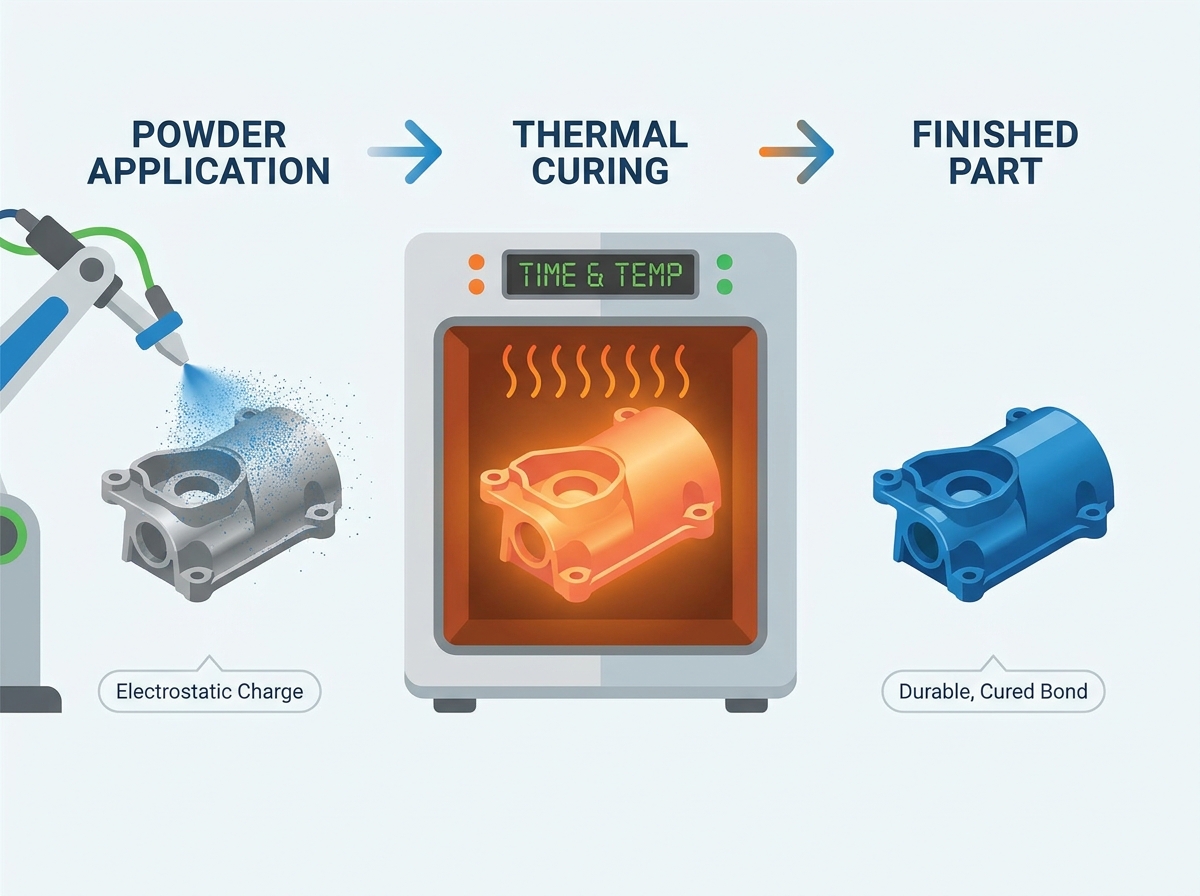
The primary goal of the curing stage is transformation. Operators must convert dry, electrostatically applied powder into a continuous polymer film. This film must bond chemically and mechanically to the aluminum substrate. Exposing thermoset powders to heat triggers a complex chemical reaction. Understanding the distinct phases of this reaction allows operators to troubleshoot defects and optimize oven settings.
When an aluminum part coated with thermoset powder enters the curing oven, it undergoes four distinct physical and chemical changes. Each phase requires specific temperature thresholds to proceed correctly.
Melt Phase: As the aluminum substrate absorbs heat from the oven, it transfers that thermal energy to the powder particles. The dry powder transitions into a liquid state.
Flow Phase: The liquefied resin spreads across the aluminum surface. Surface tension dictates how well the material levels out. Proper flow eliminates the "orange peel" texture and creates a uniform film thickness.
Gel Phase: Chemical cross-linking begins. The liquid film rapidly increases in viscosity, transforming into a rubbery, gel-like state. The coating can no longer flow or self-level at this point.
Cure Phase: The polymer chains fully cross-link. The material hardens into a dense, solid barrier. The mechanical and chemical properties lock into place, providing the final protective characteristics.
Oven set temperature is largely irrelevant on its own. Part Metal Temperature (PMT) dictates success. Aluminum has high thermal conductivity but varying thermal mass. A thick die-cast engine block heats much slower than a thin architectural extrusion. Dwell time only begins when the substrate reaches the target PMT.
Most standard powders require 10 to 15 minutes at 390°F to 400°F PMT. If an operator relies solely on oven air temperature, thick parts will under-cure. For example, a heavy casting might take 20 minutes just to reach 390°F. If the total oven time is only 25 minutes, the powder only experiences 5 minutes of actual cure time. Operators must calculate the thermal lag time for each specific component geometry and adjust conveyor speeds accordingly.
Thermal stress management prevents post-cure defects. Controlled cool-down rates maintain dimensional stability. Rapid cooling, or quenching, induces severe thermal shock. This warps thin-walled aluminum extrusions and causes micro-fractures in the cured polymer matrix, weakening chemical resistance.
Ambient air cooling allows the cross-linked structure to stabilize naturally. Thick die castings retain heat longer. They require extended cooling zones on the conveyor line before handling or packaging. Touching or moving parts while the coating remains above its glass transition temperature leads to permanent surface marring and gloss reduction.
| Curing Defect | Visual Indicator | Root Cause in Curing Process | Corrective Action |
|---|---|---|---|
| Under-curing | Dull finish, easily scratched, fails MEK test | Part never reached target PMT or dwell time was too short | Slow conveyor speed, increase oven temperature, verify with data logger |
| Over-baking | Yellowing, brittle coating, fails impact test | Part stayed at PMT too long or oven temperature was too high | Increase conveyor speed, lower oven temperature |
| Orange Peel | Heavy texture resembling citrus skin | Poor flow phase, oven heated the part too slowly | Increase initial heat zone temperature to force rapid melting |
| Thermal Warping | Dimensional distortion of the aluminum part | Rapid cooling or uneven heating in the oven | Implement ambient cooling zones, avoid water quenching |
Cast aluminum presents unique finishing challenges. Porosity is inherent in the high-pressure die-casting process. Trapped air, moisture, and mold release agents hide within microscopic surface voids. During the curing cycle, oven heat causes these trapped gases to expand rapidly. They force their way through the partially gelled powder layer. This ruptures the surface, causing pinholing, blistering, or "volcanoes." These defects expose the bare aluminum to immediate oxidation and corrosion.
Curing fails without proper adhesion profiling. Bare aluminum instantly forms a natural oxide layer upon exposure to air. This slick layer prevents strong mechanical bonding. Facilities must utilize multi-stage chemical conversion coatings to prepare the metal.
Alkaline Wash: Removes cutting fluids, stamping oils, and shop dirt.
Deionized Rinse: Washes away alkaline residue to prevent chemical interference.
Conversion Coating: Zirconium, titanium, or chromate treatments neutralize surface oxides. They etch the aluminum and deposit a microscopic conversion layer. This provides the necessary anchor profile for the powder to grip during the melt phase.
Final Seal: Locks the conversion coating in place and prevents flash rusting before the parts enter the drying oven.
Pre-baking is a mandatory step for porous castings. Operators must heat the bare aluminum parts before applying any powder. The pre-bake temperature must slightly exceed the final curing temperature. For a powder that cures at 400°F, the pre-bake cycle should run at 425°F for 20 to 30 minutes.
This thermal degassing forces trapped gases out of the substrate early. Once the parts cool to room temperature, operators apply the powder normally. The subsequent curing cycle will not trigger further outgassing because the voids are already evacuated.
Outgassing Forgiving (OGF) primers offer additional insurance against porosity defects. These specialized formulations slow the gel time during the curing cycle. The coating remains fluid for a longer duration inside the oven. This allows any remaining subsurface gases to escape freely through the liquid layer. The surface then seals smoothly without forming pinholes or craters. Using an OGF primer in conjunction with thermal degassing provides the highest success rate for heavy aluminum castings.
Operators must match the powder chemistry to the application environment. Selecting the wrong resin leads to premature failure regardless of curing precision. Let's examine the primary powder coating options for aluminum die castings and how their curing profiles differ.
Epoxy powders deliver superior chemical resistance and hardness. They bond aggressively to pre-treated aluminum substrates and provide excellent corrosion protection. However, they suffer from poor UV resistance. Sunlight exposure causes rapid chalking, fading, and surface degradation. Limit epoxy usage strictly to indoor applications, submerged components, or under-the-hood automotive parts where UV exposure is zero. Epoxies typically require a standard 400°F cure.
Polyester powders are the undisputed industry standard for exterior use. They offer excellent UV stability, weatherability, and color retention. Both TGIC and TGIC-free formulations provide strong edge coverage on sharp aluminum extrusions. You will find them heavily utilized on exterior architectural panels, window frames, and automotive trim. TGIC polyesters offer slightly better over-bake resistance, meaning they will not yellow as quickly if left in the curing oven too long.
Polyurethane powders provide a smooth, high-quality finish with exceptional flow characteristics. They bridge the gap between premium aesthetics and rugged durability. They resist chemical exposure, fuel spills, and physical abrasion effectively. Polyurethanes are ideal for high-touch surfaces and premium consumer goods. The curing window for polyurethanes is often stricter, requiring precise PMT control to avoid outgassing from the blocking agents used in the resin formulation.
Energy-efficient powders cure at significantly lower temperatures. They typically cross-link between 300°F and 350°F. This is critical for heat-sensitive aluminum alloys. Alloys like 6061-T6 can lose their metallurgical temper and yield strength under standard 400°F cycles. Low-cure formulations preserve structural integrity while reducing overall energy consumption in the facility. They are frequently used in aerospace and structural applications where metal fatigue is a primary concern.
| Powder Chemistry | Primary Advantage | Primary Limitation | Ideal Aluminum Application |
|---|---|---|---|
| Epoxy | Extreme chemical resistance | Chalks under UV exposure | Internal engine parts, indoor enclosures |
| Polyester | Excellent UV and weather stability | Lower chemical resistance than epoxy | Architectural extrusions, outdoor housings |
| Polyurethane | Premium smooth finish, durable | Strict cure window, higher cost | High-end consumer electronics, handles |
| Low-Cure | Preserves alloy temper (300°F cure) | Limited formulation availability | Structural aerospace parts, 6061-T6 alloys |
Industrial robotics demand strict coating tolerances and flawless execution. Coating powder-coated aluminum robotic die cast parts requires precision engineering at every stage of the curing process. These components face continuous motion, high friction, and exposure to industrial lubricants.
Powder coating adds measurable thickness to the substrate. A standard application adds 2 to 4 mils per surface. This severely impacts machined tolerances on robotic joints, bearing seats, and mounting faces. Facilities must implement high-temperature masking solutions before the parts enter the oven.
Silicone tapes, custom molded plugs, and die-cut masking dots protect critical mating surfaces. These masking materials must withstand 400°F curing cycles without melting or leaving adhesive residue on the aluminum. If polymer flows into a threaded hole during the melt phase, the part requires costly secondary tapping operations.
Complex robotic geometries complicate powder deposition. Deep recesses, cooling fins, and sharp internal corners repel charged powder particles. This phenomenon is known as the Faraday cage effect. Uneven application leads to localized under-curing or over-curing. If the powder is too thick in a corner, it may not cure completely. If it is too thin on an edge, it provides no protection.
Applicators must adjust gun voltage (kV), utilize specialized slotted nozzles, and control airflow to penetrate recessed areas before the parts enter the oven. Proper grounding of the aluminum part is also required to ensure an even electrostatic draw.
Robotic components operate in high-friction, high-stress environments. Fully cured coatings resist vibration, impact, and repetitive motion stress. An under-cured finish will quickly delaminate or chip under these harsh conditions. The cross-linking density achieved during the curing phase directly dictates the coating's ability to absorb mechanical shock without fracturing. Flaking powder can contaminate linear bearings and optical sensors, causing catastrophic robotic failure.
Facilities must verify that the curing process was successful before shipping parts. Visual inspection is insufficient. A part can look perfectly smooth but remain chemically under-cured. Industry-standard destructive and non-destructive tests provide objective validation of the polymer matrix.
ASTM D5402 dictates the solvent cure test. Quality control personnel saturate a cotton cloth with methyl ethyl ketone (MEK). They rub it aggressively over the cured surface for 50 double rubs. A fully cross-linked coating resists the solvent completely, showing no degradation. An under-cured film will soften, dissolve, or transfer heavy color to the cloth. This indicates a failed thermal cycle and requires the batch to be stripped and recoated.
ASTM D3359 outlines the cross-hatch adhesion test. Technicians cut a precise lattice pattern through the coating down to the bare aluminum using a specialized blade. They apply pressure-sensitive tape over the grid and remove it rapidly at a 180-degree angle. The amount of coating removed dictates the adhesion grade (0B to 5B). A 5B rating means zero coating was removed. This verifies the mechanical bond and proves the chemical pre-treatment was effective.
ASTM D2794 measures reverse impact resistance. Technicians drop a weighted indenter onto the uncoated side of the aluminum test panel. The coating on the reverse side stretches rapidly. A properly cured film will not fracture, crack, or flake. Brittle failure indicates severe over-baking, which destroys the polymer's natural flexibility. Under-cured coatings will also fail this test by delaminating from the impact zone.
Dry Film Thickness (DFT) must meet exact mil-spec requirements. Inspectors use calibrated electromagnetic or eddy current gauges to measure the cured film across multiple zones on the aluminum part. Excessive thickness causes assembly interference and increases the risk of chipping. Insufficient thickness leads to premature wear and inadequate corrosion protection. DFT readings confirm that the manual or automated application process remains consistent.
| Test Standard | Testing Method | What It Verifies | Pass Criteria |
|---|---|---|---|
| ASTM D5402 | MEK Solvent Rub | Cross-linking density (Cure completion) | No softening or color transfer after 50 rubs |
| ASTM D3359 | Cross-Hatch Tape Pull | Mechanical adhesion to substrate | 4B or 5B rating (less than 5% removal) |
| ASTM D2794 | Reverse Impact Drop | Flexibility and over-bake detection | No cracking or delamination at impact site |
| ASTM D7091 | Eddy Current Gauge | Dry Film Thickness (DFT) | Measurements fall within specified mil range |
Evaluating a powder coating service for die cast components requires a strict operational framework. You must audit their thermal management capabilities, equipment maintenance, and process controls to ensure consistent quality.
Compare convection and infrared (IR) curing ovens during your facility audit. Convection ovens provide consistent ambient heat through forced air circulation. They are better for complex geometries, deep recesses, and thick aluminum castings because the heated air wraps around the entire part. IR curing offers rapid, line-of-sight surface heating. It works best for flat, simple parts with uniform thickness, like aluminum panels. Ensure the vendor utilizes the correct oven technology for your specific part geometry.
Process documentation is non-negotiable for high-value aluminum parts. Vendors must utilize thermal data loggers like Datapaq. These devices travel through the oven attached directly to the aluminum parts. Thermocouples measure the exact surface temperature of the metal second by second. This generates a thermal profile graph. It proves the metal reached the required PMT for the correct duration, eliminating guesswork and operator error.
Evaluate how the vendor handles parts exiting the oven. Aluminum remains soft and vulnerable while hot. Improper handling of freshly cured parts leads to surface marring, fingerprints, and gloss reduction. It can also cause structural distortion in thin sections if parts are packed before reaching ambient temperature. Strict staging and cooling protocols are mandatory. Look for dedicated cooling tunnels or extended conveyor lines that allow parts to reach room temperature before un-racking.
Identify red flags immediately during a facility audit. Skipping pre-bake cycles for die castings guarantees outgassing defects. Lacking multi-stage chemical pre-treatment ensures poor adhesion and rapid corrosion in the field. Failing to document PMT verification protocols indicates a severe lack of process control. Avoid vendors who rely solely on oven air temperature dials and visual inspections to determine cure completion.
The durability of an aluminum component depends entirely on its curing cycle. Strict temperature control is mandatory. Chemical pre-treatment and outgassing mitigation are essential for porous substrates. Without these controls, even the highest-quality powders will fail in the field. Prioritize facilities that demonstrate rigorous thermal profiling. They must utilize outgassing-forgiving chemistries and maintain strict ASTM testing standards for cure validation.
Take the following steps to secure a reliable finishing partner:
Request a sample run with comprehensive thermal data logging reports attached to the specific aluminum geometry.
Demand DFT measurements and destructive testing results (MEK and Cross-Hatch) for the sample batch before approving production.
Verify the chemical pre-treatment stages match your specific aluminum alloy type and end-use environment.
Audit the vendor's high-temperature masking capabilities for tight-tolerance machined areas.
Require documentation proving that pre-baking protocols are standard operating procedure for all die-cast components.
A: Typically requires a Part Metal Temperature (PMT) of 390°F to 400°F (198°C to 204°C), though low-cure powders are available that cure at 300°F to 350°F to save energy or protect heat-sensitive alloys.
A: The dwell time is usually 10 to 15 minutes after the aluminum substrate reaches the target curing temperature. Total oven time depends on the thickness and thermal mass of the part.
A: Yes, but it requires a pre-baking (thermal degassing) step to expel trapped gases, often combined with an outgassing-forgiving (OGF) primer to prevent pinholes.
A: Under-cured powder fails to fully cross-link, resulting in a brittle finish with poor chemical resistance, low impact strength, and a high likelihood of peeling or flaking.
A: Infrared (IR) is faster and highly efficient for simple, flat aluminum parts. However, convection ovens are generally better for complex die castings because they heat the entire part evenly, ensuring curing in recessed areas.
A: The industry standard is the MEK (Methyl Ethyl Ketone) rub test. If the coating softens or transfers to the cloth after 50 double rubs, it is under-cured.
A: Standard curing temperatures (up to 400°F) for short durations generally do not significantly alter the temper or structural integrity of most commercial aluminum alloys, but specific aerospace or structural alloys should be verified with a metallurgist, potentially necessitating low-cure powders.


