
English ![]()

No. 7, Tianyang 6th Road, Dongfang Community, Songgang Street, Bao'an District, Shenzhen, Guangdong, China(518100)
Views: 0 Author: Site Editor Publish Time: 2026-11-10 Origin: Site
Applying a powder coat over an existing anodized aluminum surface happens frequently on the shop floor. You might need to salvage miscolored batches, repurpose old inventory, or hit specific dual-layer performance specs. The main problem is getting the new coating to stick. Thermoset polymer powders applied directly over an aluminum oxide layer carry a high risk of failure. Delamination and flaking occur when operators skip surface evaluation. Marine hardware or automotive components will peel within months if coated improperly. Success requires knowing the chemical state of the anodized layer. You have to find out if the pores are sealed or unsealed. Strict surface preparation protocols are mandatory before full-scale production. powder coating aluminum after anodizing works well, but only if you treat the existing finish with the right mechanical or chemical prep.
Feasibility depends on the seal: Powder coating over *unsealed* anodizing offers excellent adhesion, acting as a high-quality primer base. Coating over *sealed* anodizing typically results in adhesion failure without mechanical or chemical intervention.
Surface preparation is non-negotiable: Stripping the anodized layer or mechanically profiling the surface (e.g., sweep blasting) is usually required for previously finished, sealed parts.
Adhesion testing mitigates risk: Standardized testing (like ASTM D3359 cross-hatch testing) must be performed on sample coupons before scaling up the finishing process.
Die cast variables complicate the process: When dealing with custom aluminum die cast parts, inherent material porosity requires specific thermal management to prevent outgassing defects during the powder curing cycle.
Anodizing converts the aluminum surface into a durable finish by growing columnar pores of aluminum oxide from the base metal. This creates a hard exterior. However, a smooth, hardened oxide layer resists mechanical bonding. Powder coating needs an anchor profile. The dry powder requires microscopic peaks and valleys to grip as it melts and cross-links in the oven. Standard anodized surfaces lack this roughness. Without a physical profile, the cured polymer shell floats on the slick oxide layer. A simple physical impact will break its surface tension and cause chipping.
The seal dictates your surface preparation strategy. Unsealed anodizing leaves the columnar pore structure open. When you apply powder coating to an unsealed surface, the melting polymer flows into these microscopic voids. As the powder hardens, it forms a mechanical lock deep inside the aluminum oxide layer. This provides excellent adhesion and corrosion resistance.
Sealed anodizing blocks adhesion. Sealing hydrates the oxide layer in a hot water or nickel acetate bath. The aluminum oxide swells and closes the open pores. This creates a slick, non-porous surface that repels dirt and powder coat. Applying powder over a sealed surface leads to flaking.
| Feature | Unsealed Anodizing | Sealed Anodizing |
|---|---|---|
| Pore Structure | Open and porous | Closed and hydrated |
| Powder Adhesion | Excellent mechanical lock | Poor; prone to flaking |
| Surface Prep Required | Thermal degassing only | Mechanical profiling or chemical stripping |
| Best Application | Primer base for new parts | Standalone finish; requires rework for coating |
Standard Type II sulfuric anodizing builds a thin oxide layer, usually 0.1 to 1.0 mils thick. You can mechanically profile or chemically strip it using standard shop methods. Type III hardcoat anodizing is much denser and thicker, often exceeding 2.0 mils. The process uses lower temperatures and higher voltages to pack the oxide structure tightly for wear resistance. If a Type III surface is sealed, removing it requires aggressive mechanical abrasion. Standard chemical strippers do not break down hardcoat efficiently. Reworking it takes significant labor.
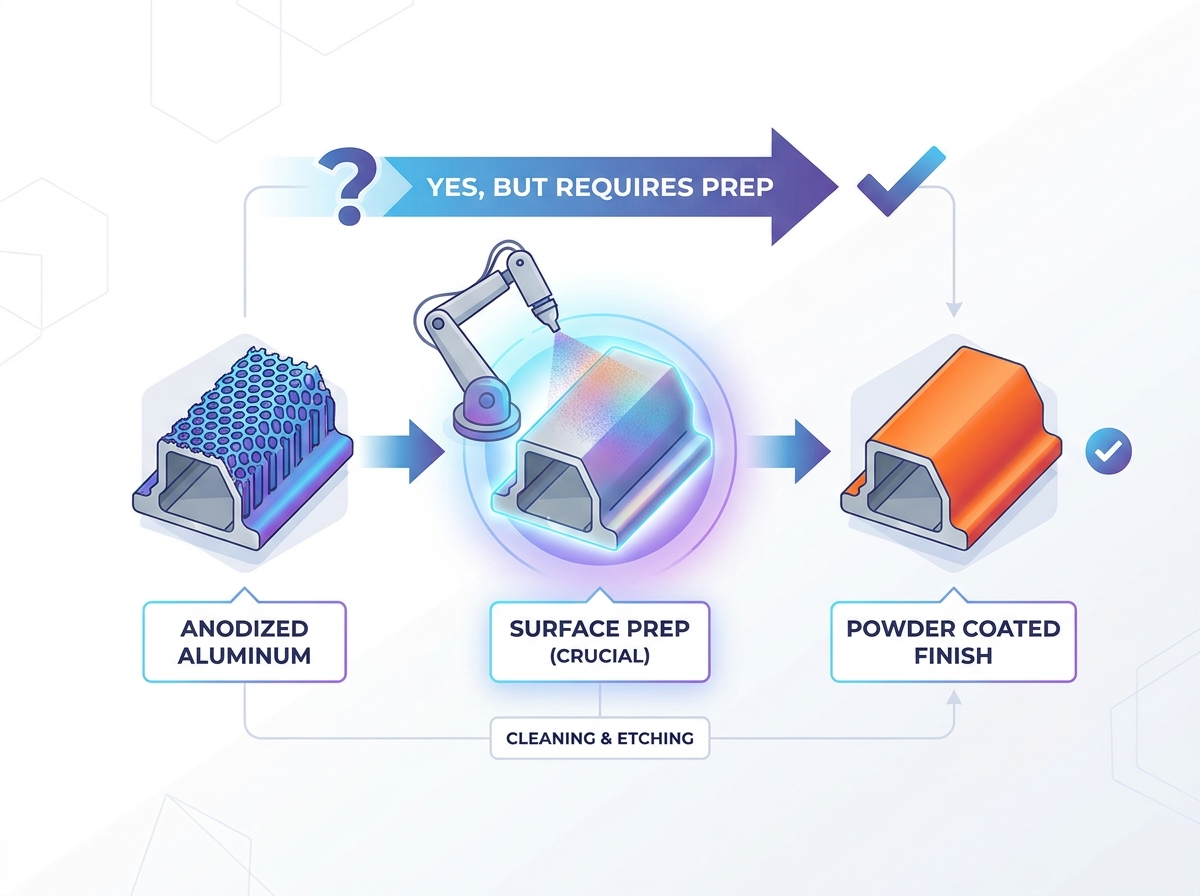
If you control the manufacturing steps, specify unsealed anodizing as a pre-treatment primer. Instruct the anodizer to skip the final sealing bath. Parts move from the anodizing line, through a clean rinse, directly into the powder coating booth. This method delivers high corrosion resistance. The unsealed oxide layer protects the raw aluminum, while the topcoat provides an impact-resistant barrier. If the powder coat scratches down to the metal, the anodized layer stops corrosion from creeping under the paint film.
For existing sealed inventory, you must create an anchor profile physically. Sweep blasting works best. Operators use fine abrasive media like crushed glass or 120-grit aluminum oxide at lower pressures (around 40-60 PSI). This lightly etches the slick surface without gouging the base metal.
Here is the standard mechanical profiling sequence:
Degrease the parts thoroughly to remove surface oils and handling contaminants.
Load parts into the blast cabinet and regulate the nozzle pressure to 40 PSI.
Sweep the blast nozzle evenly across the surface at a 45-degree angle to avoid pitting.
Blow off residual abrasive dust with clean, dry compressed air.
Inspect the surface under bright lighting for a uniform, dull matte finish.
Scuff sanding with abrasive pads works for smaller batches. However, mechanical profiling risks altering tight dimensional tolerances. Blasting too aggressively exposes bare aluminum while leaving sealed anodizing intact nearby, causing inconsistent adhesion.
Sometimes starting over guarantees the best adhesion. Chemical stripping submerges the sealed anodized parts in a heated alkaline solution, usually sodium hydroxide. The caustic bath dissolves the aluminum oxide layer, taking the part back to bare metal.
Evaluating aluminum anodizing and powder coating options means weighing the trade-offs of chemical stripping. It provides a raw aluminum base for the new powder coat. However, alkaline stripping removes a small amount of the base aluminum along with the oxide layer. This alters tight dimensional tolerances on machined threads or bearing presses. It also increases processing time and chemical disposal costs.
Anodizing is an inorganic finish. Sunlight does not affect it, and it will not degrade under heavy UV exposure. Organic powder coatings can fade, chalk, or lose gloss under prolonged UV exposure unless formulated with specific polyester or fluoropolymer topcoats. Combining the two leverages the UV stability of the base if the topcoat wears.
Anodizing integrates directly with the metal matrix. It does not peel, but it can wear thin under repetitive friction. Powder coating provides a thicker, impact-resistant shell. A powder-coated surface shows superficial scratches more readily than hardcoat anodizing, but it offers better barrier protection against blunt force impacts that dent or crack a rigid anodic layer.
Powder coating provides specialized finishes impossible to achieve through standard electrochemical anodizing. If a project requires fine-textured flat blacks, heavy metallic flakes, high-gloss safety colors, or specific RAL color matching, powder coating is the only option. Anodizing relies on translucent dyes that show the underlying metal grain and depend heavily on the specific aluminum alloy for color consistency.
Applying heat to an anodized part before spraying powder is a mandatory step. Anodized surfaces trap moisture, oils, and residual finishing chemicals within their microscopic structure. Applying powder directly over this contamination causes the trapped substances to vaporize during the curing cycle.
Thermal degassing prevents this. Pre-bake the parts in an oven at a temperature slightly higher than the final powder curing temperature. Usually, 425°F to 450°F for 30 to 60 minutes works well. This forces trapped moisture or gases to expand and escape before the polymer film forms. Skipping the pre-bake causes pinholes, blisters, and outgassing defects.
If you chemically strip the anodizing back to bare metal, you must re-establish a corrosion-resistant base. Bare aluminum oxidizes rapidly. Powder coat does not bond well to raw, untreated aluminum oxide.
Start with non-etching alkaline cleaners to remove handling oils and shop dirt. After rinsing, apply a conversion coating. Traditional chromate conversion coatings offer excellent adhesion, but environmental regulations favor zirconium-based or titanium-based non-chrome alternatives. These conversion coatings deposit a microscopic layer that stops flash oxidation and provides a chemical bonding site for the powder polymer.
Never start a full production run without validating the surface preparation. The ASTM D3359 cross-hatch adhesion test measures how well the powder coat bonds to the prepared anodized surface.
Follow these steps to conduct the test on a sample coupon:
Use a specialized 6-blade cutting tool to score a lattice pattern through the cured powder coat down to the substrate.
Brush the grid lightly to remove detached flakes or ribbons of coating.
Apply a standardized pressure-sensitive tape over the grid.
Smooth the tape down firmly using a pencil eraser to ensure good contact.
Pull the tape off rapidly at a 180-degree angle.
Inspect the grid under illumination for any detached flakes of coating.
If the coating pulls away from the anodized base, the surface preparation failed. Adjust the mechanical profiling or chemical stripping parameters and retest until the sample passes.
Die cast aluminum introduces metallurgical variables that complicate surface finishing. Foundries inject alloys like A380 into steel molds under extreme pressure. This turbulent injection process traps microscopic pockets of air and release agents beneath the dense outer skin of the casting.
This sub-surface porosity causes defects in the powder coating oven. As the die cast part heats up to 400°F, the trapped gases expand. The pressure forces the gas to the surface, blowing microscopic holes through the melting powder gel. This outgassing leaves a rough, cratered surface finish.
Die cast alloys contain high levels of silicon to improve molten metal flow. Silicon does not anodize. When you anodize a high-silicon die cast part, the aluminum oxidizes, but the silicon particles remain untouched and pool on the surface.
This reaction creates an inconsistent, dark, and smutty anodized finish. It rarely meets cosmetic requirements. Because the anodized appearance looks poor, powder coating acts as a necessary secondary step to achieve the required aesthetic finish. The anodizing remains purely for subsurface corrosion protection.
Successful powder coating for custom aluminum die cast parts requires specific mitigation strategies to handle porosity. Prolonged pre-baking cycles are mandatory. Hold the raw castings at 450°F for an hour or more to force the trapped gases out before applying powder.
Finishing shops also use outgassing-forgiving (O-GF) powder formulations. These specialized powders contain additives that alter the melt viscosity. The polymer film remains open and fluid for a longer period in the oven. This allows late-escaping gases to pass through without popping bubbles in the surface. Once the gas escapes, the powder flows back together and cross-links into a smooth shell.
Managing two distinct finishing processes across different vendors introduces quality control risks. If the anodizer seals the parts when they were supposed to remain unsealed, the powder coater will experience adhesion failure. Finger-pointing follows, leaving you responsible for the scrapped batch.
Look for partners offering comprehensive aluminum die casting surface finishing services under one roof. A vendor handling both electrochemical anodizing and electrostatic powder coating maintains strict internal quality control loops. They control the sealing baths, transfer times, and pre-bake cycles. This ensures the substrate is perfectly prepared for the final topcoat.
When faced with improperly anodized parts, engineering teams must make a rapid financial decision. Compare the costs of stripping and re-powder coating the parts against the cost of scrapping the batch and machining new components.
| Scenario | Recommended Action | Justification |
|---|---|---|
| Low-Cost Stamped Parts | Scrap and restart | Labor for stripping exceeds the raw material and stamping costs. |
| High-Value CNC Machined Parts | Chemical strip and rework | Preserves the heavy investment in spindle time and machining labor. |
| Tight Tolerance Components | Mechanical profile (Sweep Blast) | Chemical stripping alters dimensions; light blasting preserves threads. |
| Cosmetic-Only Castings | Powder coat directly over unsealed | Hides smutty cast finishes while providing a durable exterior. |
Chemical stripping and mechanical profiling take time. If the aluminum component is a simple, low-cost stamping, scrapping the batch and starting over usually costs less. If the part is a complex, tight-tolerance CNC machined enclosure with hours of spindle time invested, paying a premium for careful chemical stripping and powder coating rework makes sense to save the underlying asset.
The regulatory landscapes for anodizing and powder coating differ. Anodizing relies on heavy acid baths and generates wastewater requiring strict pH neutralization and heavy metal filtration before discharge. Powder coating is a dry process. It emits virtually zero volatile organic compounds (VOCs) and generates solid waste that is easier to manage.
Ensure your chosen vendor meets all relevant industry standards, including RoHS and REACH compliance. A vendor with modern wastewater treatment facilities and efficient powder recovery booths demonstrates the operational stability required to handle high-volume, dual-finish production runs.
Applying powder coat over anodized aluminum works, but long-term field success depends on the chemical state of the anodic layer and the rigor of your surface preparation. Ignoring a sealed oxide layer guarantees premature flaking and adhesion failure.
Use unsealed anodizing as a high-performance primer for new parts whenever possible. If you must rework existing sealed parts, utilize mechanical profiling or chemical stripping to create the necessary anchor profile and prevent delayed field failures.
Take the following actions to protect your next production run:
Request a sample run with cross-hatch adhesion testing from your finishing partner before committing to a full production order.
Verify the exact seal status of your current anodized inventory before applying any powder coat.
Specify outgassing-forgiving powders and strict pre-bake cycles when dealing with porous cast alloys.
Calculate the total cost of chemical stripping versus machining new components to determine the most efficient rework path.
A: Stripping is required if the anodized surface is sealed. The slick finish prevents powder coat adhesion and leads to peeling. If the anodizing is unsealed, you do not need to strip it. Unsealed anodizing acts as an excellent, porous primer that powder coat can bond to directly.
A: Clear anodizing is typically sealed to protect the aluminum from dirt and staining. Because it is sealed, powder coat will fail and flake off without aggressive mechanical abrasion, like sweep blasting, or chemical stripping to create an anchor profile.
A: Anodizing offers superior UV stability and will not fade in direct sunlight. Powder coating provides a much thicker, impact-resistant barrier. This prevents the finish from rubbing out under heavy friction. However, the powder coat may show superficial scratches more readily than a hardcoat anodized surface.
A: Achieving adhesion on Type III hardcoat without aggressive mechanical profiling is extremely difficult. Hardcoat is dense, thick, and slick. Standard chemical strippers struggle to remove it efficiently. Physical abrasion remains the only reliable preparation method for this surface.
A: The primary culprits for delamination are the lack of a physical anchor profile on sealed anodized surfaces and trapped moisture. If the part is not thermally degassed before coating, expanding moisture causes outgassing. This breaks the bond between the powder and the substrate.
A: Powder coating is heavily preferred for aesthetics on die castings. The high silicon content in die cast alloys does not anodize well, resulting in a dark, smutty, and uneven finish. Powder coating easily covers these visual imperfections while providing a durable, uniform exterior.


