
English ![]()

No. 7, Tianyang 6th Road, Dongfang Community, Songgang Street, Bao'an District, Shenzhen, Guangdong, China(518100)
Views: 0 Author: Site Editor Publish Time: 2026-11-12 Origin: Site
High-volume cast aluminum components frequently fail finish inspections despite powder coating acting as an industry-standard finish. This production paradox drives up scrap rates and delays shipments. The core engineering problem stems from subterranean porosity and entrapped gas release during thermal cure cycles. When parts hit the oven, trapped gases expand and rupture the curing powder film. This causes micro-blistering, pinholing, and severe adhesion loss. A costly supply chain disconnect often follows. Foundries blame finishing shops for improper cure curves. Coaters blame the casting suppliers for excessive porosity and mold release contamination. Establishing a deterministic framework for finishing these components is mandatory. You need strict controls over pre-bake thermal degassing, mechanical profiling, and chemical conversion. Integrating these steps achieves zero-defect surface protection, mechanical adhesion, and environmental compliance. We will break down the exact metallurgical and chemical controls required to stop outgassing and ensure permanent coating adhesion.
Porosity is the Primary Failure Driver: Outgassing during cure oven exposure (typically 375°F to 400°F) causes pinholing and blistering unless pre-bake thermal degassing is mandated.
Casting Process Dictates Coater Success: Conventional high-pressure die casting carries significantly higher defect risks than vacuum die casting or squeeze casting due to turbulent air entrapment.
Pre-Treatment Must Be Chemically Tailored: Standard wash systems fail on castings; multi-stage mechanical profiling and non-chrome chemical conversion are non-negotiable for corrosion resistance.
Single-Source Accountability Lowers Total Cost of Quality: Decoupling casting and coating suppliers creates margin stacking and unresolved warranty allocation when adhesion failures occur.
Castings differ fundamentally from extruded 6000-series aluminum. Extrusions provide a dense, uniform grain structure that accepts coatings predictably. Cast hypereutectic and eutectic silicon alloys, such as A380, A383, and A360, behave differently. During the solidification of molten metal inside the die, shrinkage porosity and gas porosity naturally form. Shrinkage occurs as the metal cools and contracts, leaving microscopic voids. Gas porosity happens when turbulent injection speeds trap ambient air and vaporized die lubricants inside the molten shot.
Surface-breaking voids are visible and can sometimes be filled or bridged. Near-surface micro-voids present a much larger threat. They remain hidden beneath a thin skin of solid aluminum. When you apply an electrostatic charge and introduce oven heat, that thin skin expands. The trapped gases inside the micro-voids build pressure until they breach the surface, directly impacting the integrity of the applied finish.
The thermal expansion curve of entrapped air, moisture, and vaporized lubricants accelerates rapidly between 350°F and 400°F (177°C–204°C). This temperature range perfectly overlaps with the cross-linking phase of most thermosetting powders. As the powder melts and flows, the internal gases reach maximum pressure. They mechanically erupt through the uncured powder film. This eruption leaves behind craters, bubbles, and micro-pinholes that expose the bare aluminum to the environment.
Many operators attempt to hide these defects by increasing the powder mil thickness. This approach fails. Applying a thicker layer of powder exacerbates dielectric breakdown during the electrostatic application. A heavier film also traps the erupting gases more aggressively, leading to larger surface blisters rather than a smooth finish. You cannot bury porosity under more paint; the physics of thermal expansion will always win.
Castings arrive at the finishing line carrying inherent contamination. High-temperature die lubricants, silicon sprays, and release agents penetrate deep into surface pores during the casting cycle. These chemicals are designed to prevent metal from sticking to the die, which means they also prevent powder from sticking to the metal.
Mechanical finishing adds another layer of risk. Vibratory tumbling residues or shattered blast media often become wedged inside micro-fissures. If the wash line fails to flush these particulates out, they act as localized barrier layers. Furthermore, residual casting chemistries frequently exhibit chemical incompatibility with polyester and epoxy powder polymers. This incompatibility disrupts the cross-linking process at the substrate interface, guaranteeing eventual adhesion failure in the field.
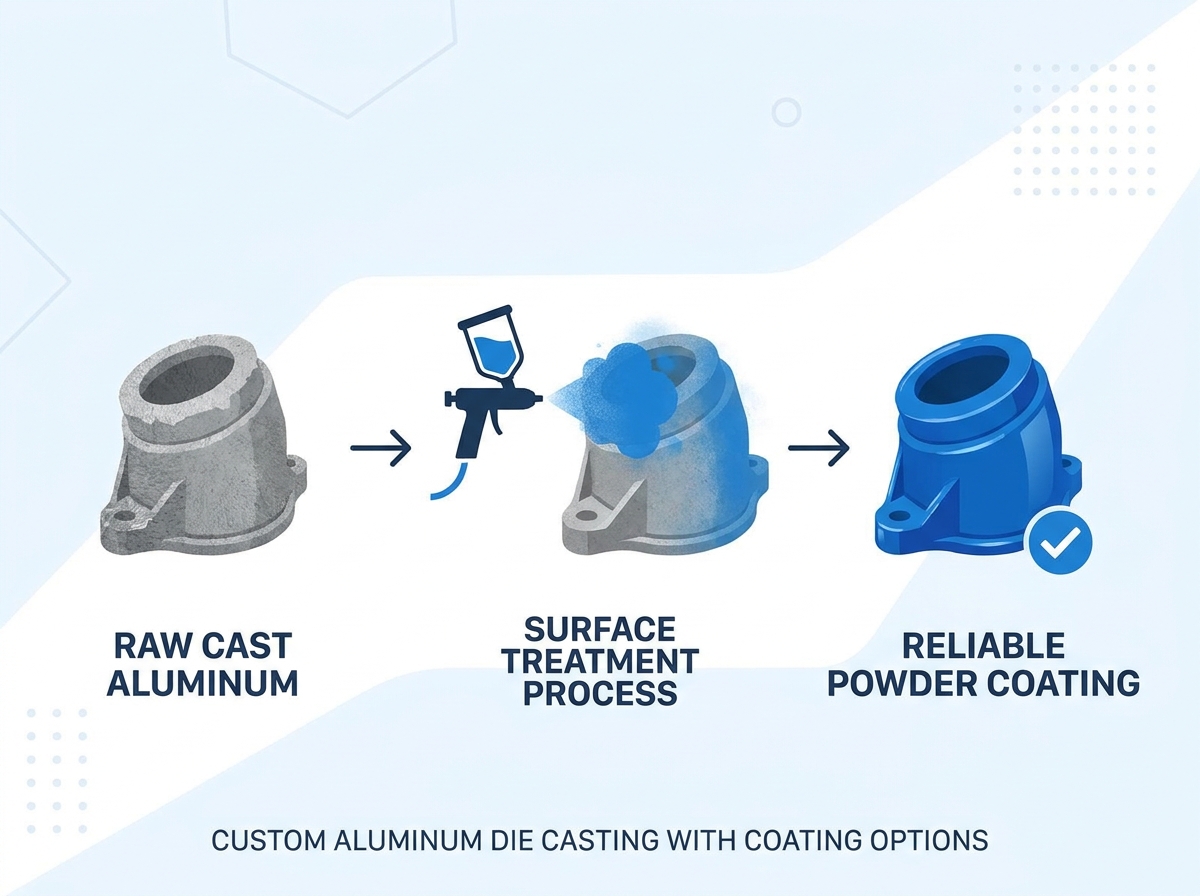
Implementing a strict aluminum die casting surface treatment process requires mandatory thermal degassing. You must establish pre-heat cycles that push the substrate temperature at least 30°F to 50°F above the final coating cure temperature. If your powder cures at 390°F, the pre-bake oven must bring the metal up to 420°F or 440°F. This forces all entrapped gases and moisture to expand and vent while the surface is still bare.
Dwell-time formulas must account for substrate mass and wall-thickness variations. A heavy, thick-walled casting requires significantly more time in the oven to reach the target core temperature than a thin-walled enclosure. Once the degassing cycle completes, control the cooling slope. Parts must cool down to the application temperature without sitting in humid environments, which prevents the porous surface from re-absorbing atmospheric moisture before powder deposition.
Chemical washes alone cannot prepare a raw casting. You need mechanical surface preparation to remove the tough outer skin and native oxides. Avoid steel shot blasting. Steel media embeds ferrous particles into the soft aluminum, creating galvanic corrosion cells that rust beneath the powder. Instead, specify non-ferrous media like aluminum oxide or garnet.
The goal of surface profiling is to achieve a surface roughness (Ra) of 1.5 to 3.0 µm. This specific roughness provides the necessary mechanical interlock for the powder without aggressively breaching internal gas pockets. Before parts enter the blast cabinet, operators must eliminate all flashing, parting line mismatches, and cold-shuts. These physical defects trap wash chemicals and cause localized coating failures if left intact.
Standard iron phosphate washes do not work on aluminum. You need a multi-stage wash system specifically designed for non-ferrous metals. The line must start with an aggressive alkaline degreaser to break down die lubricants. Next, an acid etching and deoxidation stage strips away native silicon and aluminum oxides. Deionized water rinses must follow each chemical stage to prevent hard water salt deposition.
Chemical bath management requires strict titration schedules. You must maintain optimal pH and concentration levels to prevent bath exhaustion, as depleted chemicals leave soils behind. For the final conversion layer, transition away from legacy hexavalent chromium. Zirconium and titanium-based silane conversion coatings provide excellent adhesion and corrosion resistance while maintaining full RoHS and REACH compliance. Finally, the dry-off oven must evaporate 100% of the moisture from the micro-porous cavities before the parts reach the electrostatic spray booths.
The foundation of reliable powder-coated aluminum die cast components begins with alloy selection. A380 is the most common die casting alloy due to its high availability and excellent machinability. However, its elevated silicon and copper content increases the risk of brittle intermetallic interfaces and severe outgassing. It requires aggressive deoxidation to coat successfully.
A360 offers superior fluidity during the pour and better inherent corrosion resistance. Its lower iron content yields a much cleaner surface uniformity, which directly improves powder adhesion. For structural components undergoing heavy powder film builds, A356 is the optimal choice. Typically poured in permanent mold or investment setups, A356 presents a significantly lower overall porosity profile, making it highly receptive to cosmetic finishes.
High-Pressure Die Casting (HPDC) is economical at scale but inherently violent. The high-speed injection creates turbulent flow, folding air into the metal and creating gas pockets. If you use HPDC for finish-critical parts, you must enforce ultra-tight cavity-fill monitoring and advanced gating designs to minimize turbulence.
High-Vacuum Die Casting solves many of these issues. By evacuating the die cavity and reducing internal air volume below 50 mbar before injection, this method significantly drops outgassing defects post-coating. Semi-Solid Metal (SSM) and squeeze casting take this a step further. These processes utilize laminar flow fill, which eliminates turbulent air pickup entirely. The result is a dense, extrusion-like internal structure that is immediately ready for high-temperature finishing.
Design engineers must optimize part geometry specifically for powder deposition. Avoid sudden cross-sectional transitions. Moving abruptly from a thick mounting boss to a thin cooling fin creates massive heat-sink differentials. The thin sections will over-cure while the thick sections remain under-cured.
Mitigate the Faraday cage effect by radiusing all internal corners. Sharp internal angles repel the electrostatic field, leaving bare metal in the recesses. A generous radius allows the powder cloud to penetrate and coat evenly. Additionally, engineer specific drain holes and hang-points into the CAD model. Wash line chemicals must drain freely, and the parts need secure grounding points for the electro-deposition line transfer.
Selecting the correct polymer blend dictates success when executing powder coating cast aluminum parts. Thermoset epoxies deliver exceptional chemical and mechanical resistance, making them ideal for harsh indoor industrial environments. However, they suffer from severe UV chalking and will degrade rapidly if exposed to sunlight.
For outdoor cast housings, specify TGIC and superdurable TGIC polyesters. These formulations provide high UV stability, mechanical flexibility, and excellent resistance to environmental stress-cracking. Polyurethane powders offer high flow dynamics. They melt and level smoothly over rough cast finishes, providing a balanced mix of chemical and UV resistance. Epoxy-polyester hybrids serve as a cost-effective indoor solution, balancing sharp edge coverage with high mechanical hardness.
Standard powders cross-link too quickly for castings. You need Outgassing-Mitigating (OGF) formulations. These powders incorporate specific degassing additives, such as benzoin, which lower the melt viscosity and extend the open-film state.
Extended gel times allow entrapped gases to escape through the liquid powder. Because the film remains fluid longer, it can self-heal and flow back over the pinhole before the cross-linking process locks the surface solid. Some coaters experiment with low-cure formulations (275°F–325°F) to reduce substrate thermal expansion. While this limits outgassing, it often requires a trade-off, as low-cure powders generally exhibit compromised film hardness and lower chemical resistance compared to standard 400°F cure systems.
When defects appear, you must differentiate between casting-induced failures and coating-induced failures. Casting failures typically manifest as localized porosity clusters or cold shuts that trap wash chemicals. Coating failures present as widespread under-cure, poor wash adhesion, or uneven film builds.
Blistering and pinholing require careful inspection. You must identify whether the root cause is moisture outgassing from a poorly dried part, entrapped mold release burning off, or excessive film build trapping normal off-gassing. Adhesion loss, usually identified via cross-hatch failures, traces back to chemical pretreatment exhaustion, flash rusting between the wash and the oven, or galvanic contamination from improper blast media. Faraday cage failures require adjusting electrostatic gun settings (kV/µA) and modifying powder cloud dynamics to push material into complex, deep-recess geometries.
| Defect Type | Visual Indicator | Root Cause Category | Corrective Action |
|---|---|---|---|
| Micro-Pinholing | Tiny craters on the surface | Substrate Outgassing | Implement 420°F thermal pre-bake cycle |
| Adhesion Failure | Coating peels at cross-hatch | Chemical Pretreatment | Titrate acid etch bath; check silane concentration |
| Faraday Cage Gaps | Bare metal in tight corners | Application Dynamics | Lower kV settings; increase powder flow rate |
| Blistering | Large, hollow surface bubbles | Moisture / Contamination | Verify dry-off oven temps; audit die lube usage |
| Galvanic Rusting | Red/white oxidation under film | Mechanical Prep | Switch from steel shot to aluminum oxide media |
Fragmenting your supply chain introduces massive risk. When you cast parts in one facility and ship them to a separate finishing house, you incur freight costs, re-packaging labor, and transit damage risks. More importantly, bifurcated models create disputed defect liability. When a part fails adhesion testing, the foundry and the coater will inevitably blame each other.
Evaluating turn-key suppliers that offer integrated custom aluminum die casting with coating options eliminates this friction. Single-source accountability forces the supplier to own the entire yield rate. You must establish clear scrap attribution models in your contracts, defining defect thresholds for visual classification. Differentiate between Class A cosmetic surfaces and Class C functional surfaces. Understand that mandatory degassing and multi-stage coating cycles will impact overall production scheduling and lead times.
Powder coating adds significant material to the substrate. A standard application deposits 2.0 to 4.0 mils (50–100 µm) of thickness per surface. On a precision machined bore or a tapped hole, this build-up destroys high-precision tolerances.
You must budget for masking strategies. Custom silicone plugs, die-cut high-temperature caps, and robotic masking systems protect precision geometries, but they add labor time. In some cases, secondary machining operations post-cure are more efficient than complex masking. Additionally, monitor the thermal distortion of thin-walled castings. Repeated exposure to 400°F cure cycles can warp tight-tolerance components, requiring post-coating straightening operations.
Do not rely on visual inspections alone. Implement core destructive and non-destructive verification tests based on ASTM standards. For adhesion, execute the ASTM D3359 Cross-Hatch Tape Adhesion Test. Your target must be a 4B or 5B classification, indicating zero to minimal flaking along the incisions.
Verify corrosion resistance using ASTM B117 Neutral Salt Spray Testing. Depending on your conversion coating specification, parts should withstand 1,000 to 3,000 hours without under-film creepage. Test impact resistance and hardness using ASTM D2794 for impact and ASTM D3363 for pencil hardness, targeting a 2H minimum. Finally, verify complete resin cross-linking with a Solvent Rub Test (ASTM D5402 MEK resistance) to ensure the oven cure cycle was fully effective.
Establish rigid acceptance criteria for surface appearance. Conduct all visual inspections under standardized lighting, specifically a D65 light source at a distance of 1 meter. This prevents ambient factory lighting from hiding subtle color shifts or micro-blisters.
Define allowable pore sizes and counts per square inch on non-cosmetic mounting surfaces to prevent unnecessary scrap. Specify all pre-treatment parameters, oven temperatures, and chemical concentrations on production Part Submission Warrants (PSW) and PPAP documentation. This creates factual traceability. If a field failure occurs six months later, the PPAP data allows you to audit the exact line conditions present on the day of manufacture.
Conduct a Design for Manufacturability (DFM) review to audit wall thickness uniformity, select target alloy chemistries, and define masking tolerances on part prints.
Mandate a thermal degassing pre-bake cycle that exceeds your powder's cure temperature by at least 30°F to eliminate subterranean outgassing.
Upgrade your chemical pretreatment line to include non-ferrous mechanical profiling and a zirconium or titanium-based silane conversion coating.
Specify Outgassing-Mitigating (OGF) powder formulations with extended gel times to allow residual trapped gases to escape without rupturing the finish.
Consolidate your supply chain by partnering with foundries that offer in-house vacuum casting capabilities and automated conveyorized finishing to ensure single-source accountability.
A: Bubbling occurs primarily due to outgassing. Aluminum castings inherently contain microscopic air pockets, moisture, or entrapped mold lubricants. When the part is heated in the cure oven (typically around 400°F), these trapped elements rapidly expand, venting through the molten powder layer and forming blisters or pinholes as the finish hardens.
A: Yes, for conventional high-pressure die castings and permanent mold castings, an outgassing cycle is mandatory. The pre-bake must hold the casting at a temperature approximately 30°F to 50°F higher than the powder's cure schedule to exhaust expanded gases prior to powder application. High-vacuum die castings with near-zero porosity may occasionally bypass this stage.
A: A360 and A356 alloys offer superior powder coating reliability. A356 has lower gas porosity and reduced iron content, making it ideal for structural and aesthetic parts. While A380 is the most common and cost-effective die casting alloy, its higher copper and silicon content demands rigorous surface preparation and outgassing-forgiving powder formulations.
A: Powder coating typically adds between 2.0 to 4.5 mils (50 to 115 microns) of thickness per surface. For precision bearing bores, slip fits, and tapped grounding holes, this build-up will cause out-of-spec dimensions. These critical geometries must be masked using high-temperature silicone plugs or machined as a secondary operation after powder coating.
A: Anodizing is generally unsuited for die cast aluminum components. The high silicon content (often 8% to 12%) in common casting alloys creates a dark, blotchy, non-uniform finish when chemically anodized, providing poor aesthetic value. Powder coating remains the industry-preferred surface treatment for die castings requiring uniform color, texture, and superior corrosion resistance.
A: Galvanic corrosion occurs when the aluminum substrate contacts a dissimilar metal in the presence of an electrolyte. Mitigate this by ensuring complete, pinhole-free powder coverage on the casting, using non-conductive isolation washers, or specifying anti-corrosion chemical conversion pre-treatments like zirconium or chromate beneath the powder barrier layer.


