
English ![]()

No. 7, Tianyang 6th Road, Dongfang Community, Songgang Street, Bao'an District, Shenzhen, Guangdong, China(518100)
Views: 152 Author: Site Editor Publish Time: 2026-06-12 Origin: Site
Precision manufacturing leaves zero room for guesswork. A single poor material choice can derail an entire production run. Selecting the wrong material for precision parts drives up production costs rapidly. It extends lead times due to excessive tool wear. Ultimately, it risks mechanical failure in the field.
We provide a strict, evidence-based evaluation of the most reliable metals and plastics used in commercial manufacturing. You will discover how to prioritize machinability, cost-efficiency, and end-use performance. Every raw block or billet behaves differently under the cutter. Understanding these differences protects your budget.
This guide equips engineering and procurement teams with a clear decision-stage framework. You will learn how to confidently specify materials when partnering with professional manufacturing vendors. We bridge the gap between design theory and factory-floor reality.
Machinability directly dictates production pricing; cheaper raw materials that require slower spindle speeds can result in higher overall costs.
Aluminum and Stainless Steel dominate general industrial applications, while Titanium and PEEK are reserved for extreme environments where strength-to-weight ratios justify the premium.
Transitioning from prototyping to low-volume production often requires material reassessment to optimize cycle times, particularly when utilizing complex setups like 5-Axis CNC machining.
Reputable partners provide material certifications (e.g., Mill Test Reports) to guarantee compliance for heavily regulated sectors.
Raw material price represents just one factor in your final quote. Procurement teams often chase the cheapest raw stock. They overlook how the metal behaves inside the machine. Harder materials quickly dull cutting tools. They force machinists to lower feed rates. This escalates machine hour costs significantly.
Machinability ratings measure how easily a cutting tool removes material. A high rating means faster production and cheaper parts. For example, machining tough stainless steel takes much longer than cutting soft aluminum. You pay for time. If you save twenty cents on a raw block but add five minutes of cycle time, you lose money overall.
Material rigidity directly interacts with multi-axis setups. Rigid materials hold tight tolerances well under heavy cutting forces. They benefit greatly from single-setup operations. Soft materials might deflect or bend when clamped. This requires specialized fixturing or gentler, slower cuts.
Using advanced equipment maximizes efficiency. Highly rigid stock allows operators to aggressively remove material without vibration. You eliminate chatter marks. This improves surface finish and reduces manual polishing later.
Transitioning from early prototypes to mass production carries hidden risks. A material you choose for an early-stage proof-of-concept may fail economically during high-volume runs. You might print or machine a first draft in basic ABS plastic. However, the final product might require glass-filled nylon.
You must evaluate scalability early. High-performance alloys work perfectly for one-off testing. They become financially unviable at scale. Reassessing your material before signing a massive production order prevents massive budget overruns.
| Material Category | Relative Machinability | Tool Wear Impact | Production Cost Implication |
|---|---|---|---|
| Aluminum 6061-T6 | 100% (Baseline) | Low | Highly Economical |
| Brass C360 | 100% - 120% | Minimal | Very Low Machine Cost |
| Stainless Steel 304 | 45% | Moderate to High | Increased Cycle Times |
| Titanium Grade 5 | 20% - 30% | Severe | Premium Pricing Required |
Note: When comparing quotes from different CNC machining services, ensure they are basing the machine-hour rate on the exact material grade specified. Substituting a softer alloy can artificially lower the initial bid but completely compromise part integrity.
Aluminum remains the undisputed king of custom machining. It cuts beautifully and resists rust naturally. We see two primary grades dominate the factory floor.
6061-T6: This represents the industry standard. It boasts high machinability and excellent corrosion resistance. It welds easily. Engineers rely on it for brackets, electronic housings, and general-purpose fixtures. It balances cost and performance perfectly.
7075-T6: This grade offers an incredible strength-to-weight ratio. It approaches the strength of some steel alloys. You will frequently see it specified for high-stress automotive prototyping parts and structural frames in the rapidly growing humanoid robot industry, where balancing strength and lightweight agility is critical for battery life. It lacks the weldability of 6061, but it handles extreme mechanical loads.
Stainless steel prevents contamination and fights corrosion. It presents unique machining challenges. We categorize it into three vital grades.
304 Stainless: The most common commercial grade. It offers excellent formability and reliable strength. It suits kitchen equipment and non-marine outdoor hardware.
316L Stainless: Molybdenum additions give 316L superior chemical resistance. It fights off salt water and harsh sterilizers. Medical device manufacturers and marine engineers demand this grade.
17-4 PH: "Precipitation Hardened" steel delivers extreme yield strength. It machines reasonably well in its annealed state. After heat treatment, it becomes incredibly hard. Aerospace actuators and heavy industrial shafts require 17-4 PH.
Titanium brings unmatched strength and absolute biocompatibility. It weighs roughly half as much as steel. Medical implants, jet engine turbines, and ultra-premium robotic linkages rely heavily on Grade 5 Titanium to minimize weight without sacrificing structural integrity.
Implementation reality is harsh. Titanium generates intense heat during milling. It readily work-hardens if the cutter rubs instead of slicing. It requires specialized tooling, high-pressure coolant, and exceptionally rigid 5-Axis CNC machining setups to prevent work hardening. Minimizing part handling in multi-axis machines reduces costly setup errors.
These heavy metals shine in conductivity and low-friction applications.
C360 Brass: Known as free-machining brass. It cuts faster than almost any other metal. Lead additions cause chips to break cleanly. It creates perfect custom fittings, gears, and intricate internal sliding components.
C101 Copper: Oxygen-free copper delivers ultimate thermal and electrical conductivity. It feels gummy under a cutter. Machinists must use sharp tools to prevent smearing. It dominates heat sinks and high-end electrical components.
Tip: If your automotive prototyping parts require post-machining anodizing, specify Aluminum 6061 over 7075. The zinc content in 7075 can present dark spots and color inconsistencies during the anodizing process.
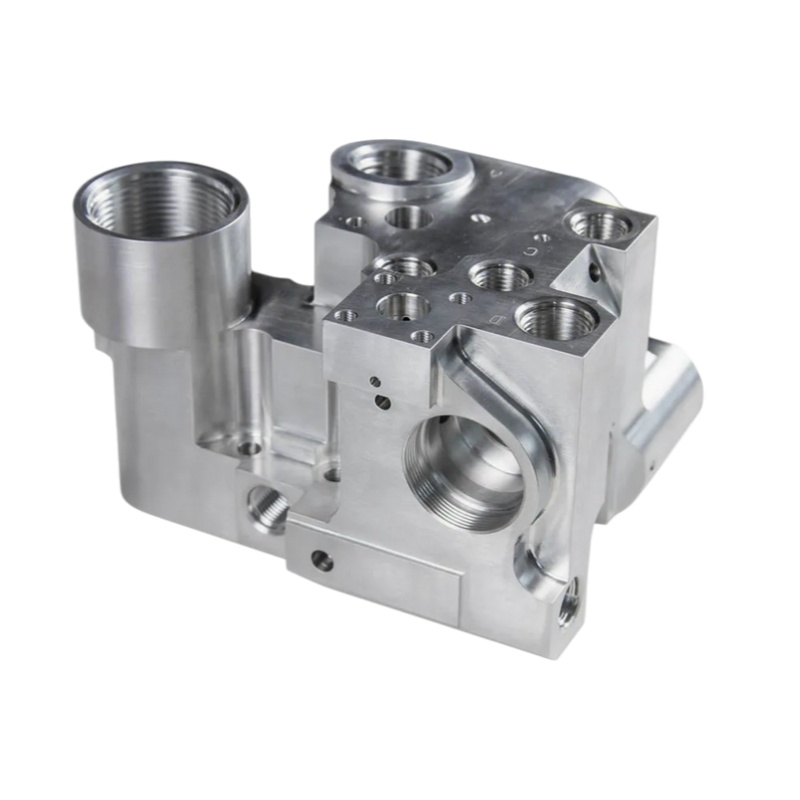
High-precision metal components undergoing advanced multi-axis machining processes.
Delrin acts as the default plastic for precision machining. It behaves remarkably like soft brass under an endmill. It chips cleanly rather than melting. You achieve tight tolerances effortlessly.
Highlight its high dimensional stability. It exhibits extremely low moisture absorption. Nylon swells in humid environments, but Delrin holds its shape. This makes it excellent for mechanical gears, wear pads, and precision bearings. It provides natural lubricity.
PEEK reigns as the ultimate high-performance engineering thermoplastic. It easily replaces metal in high-temperature, chemically aggressive environments. It handles continuous operating temperatures near 480°F (250°C). Aerospace engineers and oil & gas operators rely on PEEK.
You must address the high raw material cost. PEEK billets cost drastically more than aluminum. It also demands precise thermal control during machining. Machinists use annealed grades to prevent the material from cracking as they remove heavy layers.
When you need transparency, you choose PC or PMMA. They behave very differently.
Polycarbonate brings extreme impact resistance. It creates bulletproof glass and tough machine guards. It machines easily but can scratch.
Acrylic offers superior optical clarity. It transmits light better than glass. However, it is brittle. It shatters easily if clamped too hard. It requires specific tooling strategies. You need high spindle speeds and slow feed rates. This prevents localized melting or chipping during the milling process. Proper coolant stops the chips from re-welding to the workpiece.
The principles of material selection become even more critical when machining for highly specialized industries like humanoid robotics and precision optics. Matching the right alloys to specific operational demands is how we solve complex engineering challenges.
For example, in a recent project manufacturing advanced telescope assemblies for a Belarusian client, strict material mapping was essential to prevent thermal distortion and ensure optical alignment. We utilized dimensionally stable Aluminum alloys for structural components like the Frame, Body, Carriage, and Plank. To ensure smooth, wear-resistant adjustments, internal mechanisms like the Rack, Sleeve, Flange, and Fixer were machined from specialized brass and low-friction Delrin. Finally, securing the delicate lenses required perfectly machined Gaskets, Catchers, Coils, and Holders, utilizing materials engineered to maintain strict tolerances under varying weather conditions. Whether building the structural skeleton of a humanoid robot or the intricate chassis of a telescope, proper material pairing is the foundation of product success.
Choosing the right alloy dictates the success of your project. Evaluating CNC machining services involves checking their experience with your chosen material. We structured a systematic approach for procurement teams.
Map Mechanical & Thermal Requirements: First, you must map yield strength, tensile strength, and operating temperature to the correct material family. If your part operates at 300°C, you immediately eliminate aluminum and most plastics. You pivot toward Titanium or PEEK. If the part handles high cyclic loads, you check the fatigue strength of 7075-T6 against steel. When sourcing CNC machining materials, prioritize operational safety margins over minor raw cost savings.
Verify Compliance and Certification (Risk Mitigation): Regulatory compliance protects your business. You must understand the importance of ISO, RoHS, and REACH compliance. Electronics must not contain banned substances. Medical and aerospace buyers face even stricter rules. Verifiable material tracing is non-negotiable. You need Mill Test Reports (MTRs) to prove the block of Titanium you bought is actually aerospace-grade.
Confirm Surface Finish and Post-Processing Compatibility: How does material selection limit or enable finishing options? Not all metals take all finishes. You can bead-blast most metals. However, you can only anodize aluminum and titanium easily. You cannot color-anodize steel. If you need electropolishing for surgical tools, you must start with a compatible stainless steel like 316L. Powder coating requires the material to survive curing oven temperatures without warping.
Note: Always verify that your chosen manufacturing partner has verifiable experience machining your specific material. A shop optimized for high-speed aluminum production may struggle terribly with the stringent thermal management required for PEEK or Titanium.
Heat destroys precision. Milling generates intense friction. Plastics and certain metals deform under machining heat. This causes severe tolerance drift. You might measure the part on the machine and find it perfect. Once it cools down on the inspection table, it shrinks out of spec.
Top-tier machinists mitigate this with optimized coolant strategies. They use high-pressure flood coolant or air blasts to evacuate chips rapidly. They also build resting periods into the code. Pausing allows the block to normalize to room temperature before taking the final precision finish cut.
Raw materials contain locked-in forces. Extruding plastics or cold-rolling steel traps internal stresses. As the endmill removes material, these stresses release. The remaining metal violently bows or twists. A perfectly flat plate turns into a potato chip.
You avoid this by purchasing stress-relieved materials. Pre-treatments matter. Engineers often specify cast aluminum tooling plate (like MIC-6) instead of standard extruded 6061 for large, flat fixtures. Cast plates contain almost zero internal stress. They remain perfectly flat after heavy machining.
Engineers often fall into a costly trap. They default to aerospace-grade materials for non-critical components. They specify Titanium for a cosmetic desk bracket. They request PEEK for a simple spacer that never sees heat.
This unnecessarily inflates part costs. It slows down procurement. You must practice value engineering. Match the material explicitly to the actual operating environment. If a standard Delrin gear works for 10,000 cycles, do not pay 10X more for PEEK unless the specifications absolutely demand it.
Precision manufacturing demands a critical balance between material properties, machinability, and overall cost. You cannot look at raw material prices in a vacuum. A cheap, tough steel block will cost you heavily in machine time and broken endmills.
The best material choice depends entirely on matching part geometry and end-use application with the right factory capabilities. Aluminum and Delrin cover the vast majority of industrial needs. Extreme environments justify the premium costs of Titanium and PEEK.
Stop guessing about machinability. Encourage your design teams to consult with experienced manufacturing engineers early in the development cycle. Upload your CAD files to specialized CNC machining partners for a complete Design for Manufacturability (DFM) review. A professional review provides a precise material cost breakdown and protects your production timeline.
A: Aluminum 6061-T6 represents the most cost-effective metal. It offers excellent machinability, meaning faster cycle times and lower tool wear. For plastics, Acetal (Delrin) serves as the baseline. It cuts quickly, holds tight tolerances, and remains highly economical for low-to-medium production runs.
A: No, 5-Axis machines handle all standard materials. However, their high hourly cost is best justified by complex geometries or hard-to-machine metals like Titanium. Minimizing setups on these machines drastically reduces errors and cycle times for difficult alloys.
A: Use a simple heuristic: weight and speed versus strength and corrosion resistance. Choose aluminum if your part needs to be lightweight, dissipate heat quickly, or requires cost-effective high-speed machining. Choose stainless steel if the part faces extreme mechanical stress, harsh chemicals, or requires strict hygiene protocols.
A: Yes. Modern multi-axis machining achieves incredible surface finishes and tight tolerances. Proper material selection and post-processing allow machined parts to match or exceed the performance of injection molding or casting, especially for low-to-mid volume end-use production runs.


