
English ![]()

No. 7, Tianyang 6th Road, Dongfang Community, Songgang Street, Bao'an District, Shenzhen, Guangdong, China(518100)
Views: 0 Author: Site Editor Publish Time: 2026-08-24 Origin: Site
The operational ceiling of any robotic arm—defined by payload capacity, repeatability, and kinematic accuracy—is strictly limited by the mechanical tolerances of its foundational components. Off-the-shelf structural parts and generic fasteners introduce tolerance stacking, backlash, and excess weight. These flaws degrade precision and increase wear in automated systems. Engineers face a bottleneck when scaling from theoretical kinematic models to physical, reliable hardware. Standard brackets flex under dynamic loads. Generic gear housings fail to maintain the strict concentricity required for zero-backlash power transmission. To achieve sub-millimeter repeatability, optimize weight-to-strength ratios, and survive harsh industrial environments, robotics manufacturers must move beyond standard catalogs. This necessitates bespoke manufacturing to produce custom joints, housings, and end-effectors that align exactly with specialized engineering requirements. We need parts designed for specific load paths and machined to exact geometric tolerances.
Precision is Non-Negotiable: Custom CNC machining eliminates tolerance stacking in robotic joints, directly improving the absolute accuracy and repeatability of the robotic arm.
Material Optimization: Machining allows for the use of aerospace-grade aluminum, titanium, and advanced polymers, optimizing the arm's weight-to-payload ratio.
Rapid Customization for Tooling: Because end-of-arm tooling and fixtures are often one-off requirements, CNC machining provides the short lead times and exact specifications needed for custom applications.
Application-Specific Compliance: High-stakes environments require stringent manufacturing standards, making custom CNC machining for medical components and aerospace applications a regulatory necessity.
Strategic Sourcing: Selecting a machining partner requires evaluating their 5-axis capabilities, quality assurance protocols (like CMM inspection), and Design for Manufacturability (DFM) expertise to mitigate production risks.
Robotic arms operate on complex kinematic chains. A minor deviation at the base joint amplifies exponentially by the time it reaches the end-effector. Standard off-the-shelf brackets and generic housings often feature loose manufacturing tolerances. When you bolt these generic parts together, the minute dimensional variations stack up. This tolerance stacking causes significant positioning errors. If a base plate is off by just 0.05 millimeters, the tool center point at the end of a one-meter arm could miss its target by several millimeters. Precision robotics require exact concentricity, parallelism, and flatness to ensure kinematic models match physical reality. We see this constantly on the assembly floor. You try to pin a standard cast bracket, and the holes do not align perfectly with the mating bearing journal. You end up forcing the fit, which pre-loads the bearing and guarantees premature failure.
Managing inertia is a primary challenge in robotics design. Cast metal parts or standard aluminum extrusions carry excess mass. They feature uniform wall thicknesses that do not account for optimized load paths. Excess weight in the structural links of an arm directly reduces the allowable payload. It also forces servo motors to work harder to overcome inertia, slowing down cycle times and increasing energy consumption. Engineers need components that maximize the strength-to-weight ratio. Standard parts simply cannot provide the localized thinning and strategic pocketing required to shed dead weight without compromising structural integrity. When you machine a custom link from a solid billet, you can leave thick ribs exactly where the bending moments are highest and mill out deep pockets in low-stress zones. This approach drops the arm's mass significantly, allowing you to spec smaller, faster motors.
High-performance robots rely on specialized drive mechanisms. Harmonic drives, cycloidal gearboxes, and high-torque servo motors require exact mounting conditions. Generic enclosures fail to provide the precise bearing journals and alignment pins necessary for these drives to function without binding. Proprietary drive systems generate significant heat during continuous operation. Standard housings lack the integrated cooling fins or thermal dissipation pathways needed to protect sensitive optical encoders and stator coils from thermal degradation. We often machine custom motor mounts with integrated liquid cooling channels directly into the aluminum housing. You cannot buy that out of a catalog.
Industrial robots operate in hostile environments. They face constant exposure to high-pressure coolant, flying metal chips, welding spatter, and corrosive chemicals. Standard enclosures rarely achieve the strict Ingress Protection (IP) ratings required for these settings. Off-the-shelf boxes often have uneven mating surfaces that prevent O-rings from sealing properly. When coolant or dust breaches the housing, catastrophic electrical or mechanical failure follows. Engineers must specify machined enclosures with perfectly flat sealing faces and custom O-ring grooves to guarantee long-term survival on the factory floor. A milled O-ring groove with a 32 micro-inch finish ensures the seal seats perfectly, keeping 1000 PSI coolant out of your servo encoders.
To overcome the limitations of standard parts, manufacturers rely on custom CNC machining to produce bespoke components tailored to exact kinematic and environmental requirements.
The primary skeleton of a robotic arm consists of structural links and joint housings. These parts demand high rigidity and low weight. Machining these components from solid billets of aerospace-grade aluminum prevents the flex and deflection common in stamped or cast alternatives. Monolithic machined designs integrate mounting points, cable routing channels, and bearing seats into a single piece. This reduces the total part count and eliminates the weak points associated with bolted assemblies. Dynamic loads during rapid acceleration and deceleration require structural integrity that only solid machined metals can provide. We regularly machine monolithic bicep links for 6-axis robots. By cutting the entire link from one block of 7075-T6, we eliminate three separate bolted joints, drastically increasing the stiffness of the arm.
Heavy-duty gantry systems expand the work envelope of robotic arms, allowing them to traverse large factory spaces. These systems rely on massive linear rails and rack-and-pinion drives. Machining the structural beams for gantry robots requires immense precision over long distances. The mounting surfaces for linear guideways must be perfectly parallel and flat. Any undulation in the machined surface causes the bearings to bind, resulting in vibration and premature wear. Precision milling ensures smooth, vibration-free movement across the entire gantry travel path. When setting up a 10-meter gantry, the rail mounting pads must be milled coplanar within a few thousandths of an inch. We use large-format bridge mills to hit these tolerances in a single setup.
The end-effector is where the robot interacts with the workpiece. Grippers, vacuum plates, specialized welding heads, and custom fixtures are rarely standard. Every manufacturing line handles unique part geometries. EOAT requires bespoke machining to interface perfectly with the target object. Complex internal routing for pneumatic lines or vacuum channels can be milled directly into the tooling plates. Because these fixtures are often one-off requirements for specific production runs, machining provides the rapid turnaround and exact specifications necessary to keep automation lines moving. We frequently machine custom vacuum plenums out of Delrin. We drill intersecting cross-holes to route the vacuum to specific suction cups, then plug the ends. It creates a clean, hose-free end effector that will not snag on surrounding equipment.
Power transmission in a robotic joint requires zero backlash. Gearbox enclosures must hold gears, shafts, and bearings in perfect alignment. Tight-tolerance machining is mandatory for these housings. If the center-to-center distance between two gear shafts is off by a fraction of a millimeter, the gears will either bind or exhibit excessive play. Precision bored bearing seats ensure that harmonic drives operate smoothly, transferring maximum torque without introducing positioning errors. We bore these bearing pockets using specialized boring heads to hold diametrical tolerances of +/- 0.0002 inches. You cannot achieve that with standard drilling or rough milling.
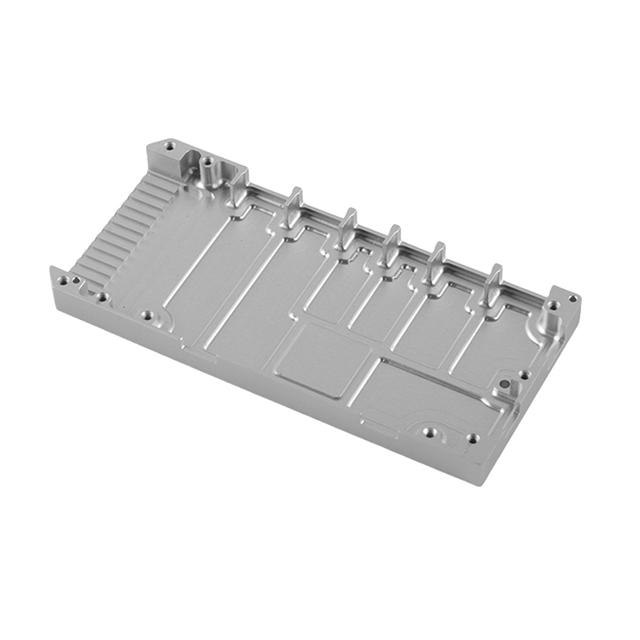
Modern manufacturing features a unique dual relationship: CNC machines cut the parts that build robotic arms, and those same robotic arms are deployed to tend the CNC machines. Machine tending involves autonomous part loading and unloading. A robot retrieves raw billets from a pallet, secures them in the machine's hydraulic chuck, and removes the finished components. This automation loop requires the tending robot to operate flawlessly over thousands of cycles. The robot itself relies on custom machined grippers and rigid joints to maintain the exact positioning needed to load parts without crashing the machine tool. If the robot's wrist joint has backlash, it might misalign a billet in the chuck jaws, causing a catastrophic crash when the spindle starts.
Robots tasked with tending machines endure high physical stress. They handle heavy raw materials and maneuver massive finished products. They also operate inside the machine envelope, exposing their joints to aggressive cutting fluids and sharp swarf. The structural components of these tending robots must be ultra-rigid to prevent deflection when lifting heavy loads at full extension. Custom-machined structural parts ensure the arm remains stiff and accurate, preventing dropped parts or misaligned loading sequences during continuous, unattended operation. We build tending robots with heavy-duty cast iron or steel base plates, machined flat to ensure they bolt rigidly to the shop floor without inducing twist into the robot's base casting.
Sourcing components for robotics requires strict adherence to engineering specifications. custom precision CNC machining provides the control necessary to meet these exact standards.
The success of a machined robotic part is defined by its adherence to Geometric Dimensioning and Tolerancing (GD&T). Engineers do not just specify basic dimensions; they dictate true position, concentricity, parallelism, and perpendicularity. Bearing bores often require tolerances as tight as +/- 0.005mm to ensure proper press fits. Mating surfaces must meet strict flatness callouts to prevent the introduction of angular errors when joints are bolted together. Repeatability in the machining process ensures that part number one is identical to part number one hundred, allowing for seamless assembly and field replacements. We use rigid tapping and thread milling to ensure every tapped hole is perfectly perpendicular to the mating face, preventing bolt head binding during assembly.
Material selection dictates the performance limits of the robotic arm. Machining allows engineers to choose specific alloys based on localized stress profiles.
Aluminum 6061-T6 provides excellent machinability and corrosion resistance for general structural links.
Aluminum 7075-T6 offers higher tensile strength, ideal for high-stress mounting plates.
Titanium Ti-6Al-4V delivers an exceptional strength-to-weight ratio for critical wrist joints and aerospace applications.
Engineering plastics like PEEK or Delrin provide electrical isolation and low-friction surfaces for internal cable management and wear pads.
Stainless Steel 17-4 PH offers extreme durability and corrosion resistance for exposed shafts and medical tooling.
Material Comparison for Robotic Components
| Material | Primary Advantage | Common Robotic Application | Machinability |
|---|---|---|---|
| Aluminum 6061-T6 | Lightweight, highly workable | Structural links, generic housings | Excellent |
| Aluminum 7075-T6 | High strength-to-weight ratio | High-stress brackets, base plates | Good |
| Titanium Ti-6Al-4V | Extreme strength, heat resistance | Aerospace joints, compact wrist mechanisms | Challenging |
| Stainless Steel 17-4 PH | Corrosion resistance, durability | Medical robotic tools, exposed shafts | Moderate |
| PEEK | Electrical isolation, low friction | Cable guides, insulating spacers | Good |
Raw machined metal is rarely ready for robotic assembly. Surface treatments extend the lifecycle of the components. Hard coat anodizing (Type III) on aluminum parts creates a wear-resistant surface that prevents scratching and corrosion. Electroless nickel plating provides a uniform, lubricious coating on steel components, preventing galling in moving parts. Precision grinding is often applied to bearing journals and gear shafts to achieve mirror-like surface roughness (Ra) values, reducing friction and heat generation during high-speed rotation. We often mask off critical bearing bores before anodizing to maintain the tight machined tolerances, ensuring the bearings press in perfectly without scraping off the anodized layer.
Robotic arms deployed in aerospace manufacturing, satellite maintenance, or planetary exploration face extreme operational environments. custom CNC machining for aerospace components requires strict adherence to AS9100 quality standards. Traceability is mandatory; every piece of metal must be tracked back to its original mill melt. Aerospace robots require aggressive lightweighting strategies, utilizing complex pocketing and thin-wall machining to save every possible gram. These components must withstand extreme temperature fluctuations and vacuum environments, necessitating the use of specialized titanium alloys and space-rated surface treatments that prevent outgassing. We machine titanium wrist joints with wall thicknesses down to 0.040 inches, requiring specialized workholding to prevent the part from vibrating or collapsing under cutting pressure.
Surgical robotic arms and laboratory automation systems prioritize patient safety and biological compatibility. custom CNC machining for medical components operates under ISO 13485 regulatory frameworks. Parts must be machined from biocompatible materials like surgical-grade stainless steel (316L or 17-4 PH) or titanium. Surface finishes are critical; any microscopic burrs or porous surfaces can harbor bacteria. Medical robotic components require sterilization-ready finishes, often achieved through electropolishing or passivation, ensuring they can withstand repeated autoclave cycles without degrading. We run specific tumbling and deburring processes to ensure zero sharp edges remain on any surgical robot component, protecting both the patient and the surgical staff.
Selecting the right machining technology impacts both cost and precision. 3-axis machining is highly cost-effective for flat, two-dimensional parts like simple EOAT mounting plates or basic brackets. However, robotic joint housings are inherently complex, featuring compound angles and intersecting bores. Using a 3-axis machine for these parts requires multiple manual setups. Every time a machinist unclamps and repositions the part, alignment errors are introduced. 5-axis machining allows the cutting tool to approach the part from nearly any angle in a single setup. This reduces setup time and ensures absolute concentricity between opposing bearing bores, though it comes at a higher hourly machine rate. We always push complex joint housings to the 5-axis mills to guarantee the true position tolerances between the motor mount and the output shaft.
The cost structure shifts dramatically when scaling from a single proof-of-concept arm to a low-volume production run. Prototyping incurs high upfront programming and setup costs distributed over a single unit. Engineers often use softer, cheaper materials for initial fit-checks. When moving to low-volume production, the focus shifts to cycle time optimization and scalable fixturing. Investing in custom workholding fixtures allows multiple parts to be machined simultaneously, drastically reducing the per-unit cost for batches of 50 to 100 robotic arms. We design tombstone fixtures for our horizontal machining centers that hold eight joint housings at once, allowing the machine to run unattended for hours.
Engineers must avoid the trap of over-tolerancing. Applying a blanket +/- 0.001-inch tolerance across an entire part drives manufacturing costs exponentially higher. Tight tolerances require slower feed rates, frequent tool changes, and extensive inspection routines. A practical decision framework involves applying ultra-tight tolerances only to critical mating surfaces, bearing press-fits, and dowel pin holes. Non-critical areas, such as external cosmetic surfaces or clearance holes, should be assigned relaxed tolerances. This strategic approach controls costs without sacrificing the kinematic performance of the robot. If a surface just sits in open air, give it a +/- 0.010-inch tolerance. Save the tight callouts for the bearing journals.
Delayed component delivery can halt an entire robotic assembly line. Relying on a single offshore supplier exposes manufacturers to shipping delays, customs holds, and geopolitical disruptions.
Mitigation: Evaluate vendors based on their machine redundancy and raw material sourcing networks. Partner with machine shops that have multiple 5-axis centers to ensure production continues even if one machine goes down. Establish clear lead-time guarantees and buffer inventory agreements. We keep backup tooling and duplicate fixtures on the shelf so we can swap a hot job onto another machine in minutes if a spindle goes down.
An out-of-spec part that slips past quality control has catastrophic impacts. If a joint housing with an oversized bearing bore reaches the assembly floor, it introduces backlash that ruins the robot's repeatability.
Mitigation: Require comprehensive inspection documentation before accepting parts. Mandate First Article Inspection (FAI) reports for new designs. Ensure the vendor utilizes Coordinate Measuring Machines (CMM) to verify complex GD&T callouts and request material test reports (MTRs) to verify alloy composition. We probe every critical bore on the machine before the part is unclamped, then verify it again on the CMM in a temperature-controlled room.
Engineers sometimes design parts that are physically impossible or prohibitively expensive to machine. Deep, narrow pockets with sharp internal corners cannot be cut with standard end mills.
Mitigation: Partner with CNC machine shops that offer proactive upfront DFM engineering support. Experienced machinists can suggest minor design tweaks—such as standardizing internal radii or altering hole depths—that optimize geometries before any chips are cut, saving significant time and money. If you design a pocket that is 3 inches deep with a 1/16-inch corner radius, we will flag it immediately and suggest a larger radius to allow for a thicker, more rigid cutting tool.
Off-the-shelf components cannot support the precision, payload, and durability requirements of modern industrial and collaborative robots. The mechanical foundation dictates the software's ability to control the arm accurately. Custom precision CNC machining is a foundational requirement for high-performance robotics, eliminating tolerance stacking, optimizing weight, and ensuring environmental resilience. Selecting the right manufacturing partner requires a strict shortlisting logic. Look for vendors with proven 5-axis capabilities, verifiable CMM quality control, and industry-specific certifications like AS9100 or ISO 13485. Proactive DFM communication is the hallmark of a partner who will actively work to reduce your production costs.
Audit your current robotic component designs to identify areas where tolerance stacking occurs or where weight can be optimized.
Standardize internal corner radii and relax tolerances on non-critical surfaces to improve manufacturability.
Gather your CAD files and define your critical GD&T requirements for all bearing bores and mating surfaces.
Submit a Request for Quote (RFQ) to a specialized precision machining partner with verified 5-axis capabilities.
A: CNC machining provides superior material strength, fatigue resistance, and tighter tolerances compared to 3D printing. Load-bearing robotic joints require the isotropic strength of solid metal billets to handle dynamic forces without deflecting or fracturing. Machining also achieves the precise surface finishes necessary for bearing seats and gear alignments.
A: Aluminum 6061 and 7075 are the most common due to their excellent strength-to-weight ratios. Titanium is used for high-stress, lightweight aerospace joints. Stainless steel is preferred for medical and washdown environments. Engineering plastics like Delrin and PEEK are machined for low-friction wear pads and electrical isolators.
A: It eliminates tolerance stacking and mechanical backlash. By machining mating surfaces, bearing bores, and gear housings to exact GD&T specifications, the physical assembly mirrors the theoretical kinematic model. This ensures the end-effector returns to the exact same sub-millimeter coordinate every cycle without deviation.
A: Yes, custom EOAT is one of the most frequent applications for CNC machining. Grippers, vacuum plenums, and custom fixtures require bespoke geometries to match unique workpieces. Machining provides the rapid lead times and exact tolerances needed to deploy custom tooling quickly on the factory floor.
A: Robotic arms are highly suited for automating the loading and unloading of CNC machines. However, the arms themselves must be constructed from highly rigid, custom CNC machined components to withstand the heavy lifting, repetitive stress, and harsh coolant exposure inherent in the machining environment.
A: Tolerance requirements vary by function. General structural links and external housings typically require +/- 0.005 inches. Critical internal features, such as bearing bores, gear shaft alignments, and dowel pin holes, often demand ultra-tight tolerances ranging from +/- 0.0005 to +/- 0.001 inches to ensure proper press fits.
A: Reduce costs by standardizing internal corner radii to match common end mill sizes. Relax tolerances on non-critical cosmetic surfaces. Design parts to be machined in a single setup on a 5-axis machine, and engage with your manufacturer early for Design for Manufacturability (DFM) feedback.


